Disclosure Partner links are marked. We may earn a commission if you use one. It costs you nothing extra and never changes our verdict. How we review
How to size a position is a cash decision you make before the order. You pick the loss you can take if the stop is hit, measure that stop, and let those two numbers set the lots. This guide walks one labelled example on XAUUSD, then the exchange contract pages and the regulator risk pages behind the inputs.
How do you size a position?
How to size a position is to choose the cash you will lose if the stop is filled, then divide that cash by the loss on one lot over the same stop.
That order is the whole rule. Most accounts get into trouble the other way round: a trader picks 1.00 lot because it looks like a normal size, then discovers the stop is so far away that one loss is a large slice of the account. The lot was a guess. The cash was a surprise.
Start from the cash. A common working figure is a small percent of the account on any single order, small enough that several stopped trades in a row still leave the account able to function. One percent is the figure in the example below. It is an example, not a rule that fits every account. Someone living on the account, or already carrying other open risk, may need a smaller percent. Write the percent down before the session, and use the same percent on the next order so a bad morning does not quietly raise it.
The stop comes from the chart, from the place where the idea is wrong. It is a price distance. Once you have the distance in pips and the cash you are willing to lose, the lot size is arithmetic. There is nothing left to negotiate with the chart.
Two habits keep the rule honest. First, size every order, including the one that feels obvious. Second, change the lots when the stop changes. A setup with a stop twice as far away gets about half the lots, for the same cash. The idea can be the same. The size is not.
What is a position size calculator?
A position size calculator takes an account size, a risk percent, a stop distance and a pip value, and it returns the lot size that puts that cash at the stop.
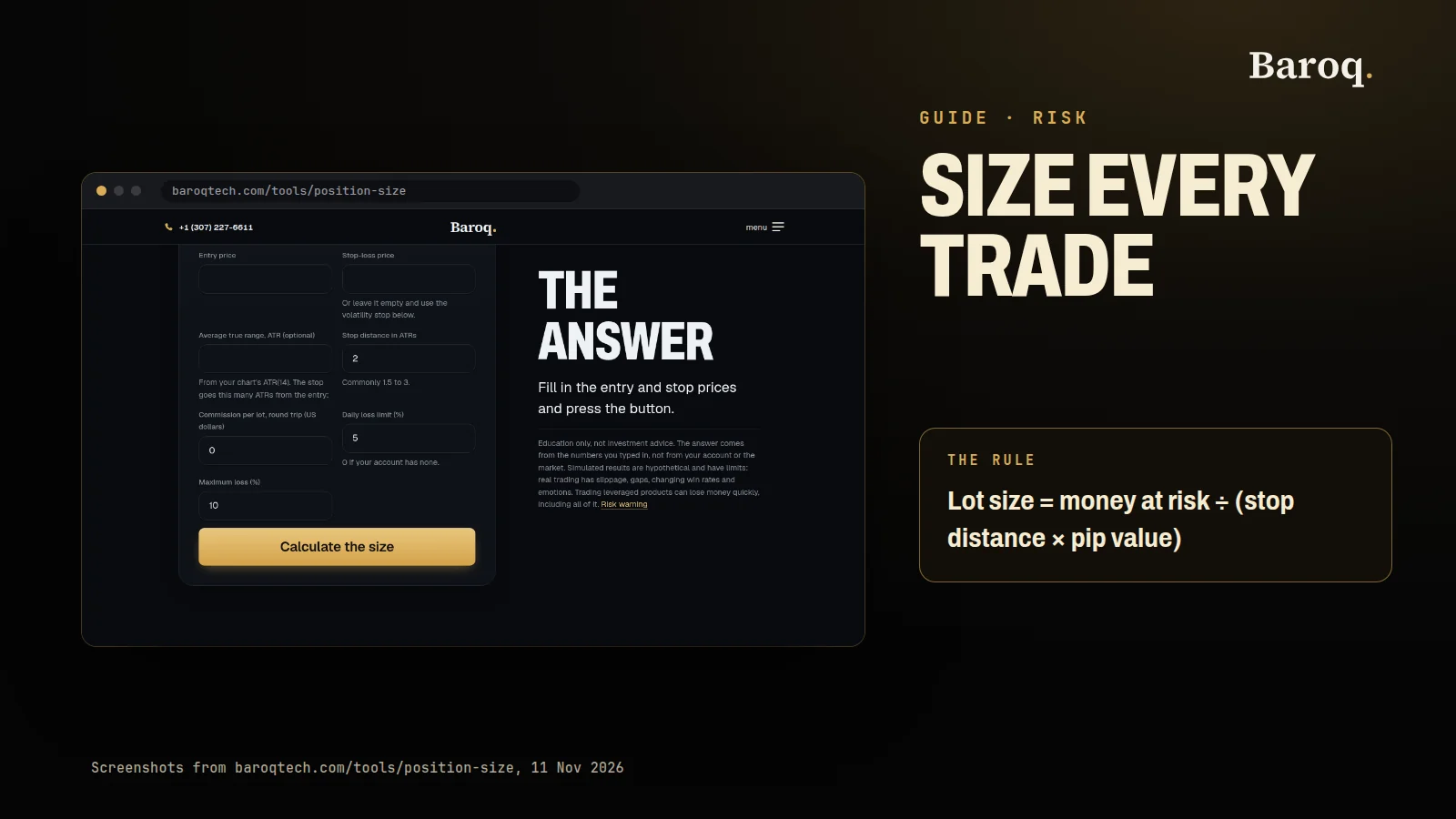
You can do the same division on paper. The calculator is there so the arithmetic is the same every time, and so a tired session does not slip a zero. Baroq's free position size calculator is the card at the end of this page. It is a form: you type the numbers, it divides. It does not watch your account, and it does not send an order.
What you type has to be the real contract. If the pip value in the box is wrong, the lots are wrong by the same proportion. If your symbol pays a commission per lot, that cost belongs in the cash at risk as well. A calculator that ignores commission will print a size that is a little too large once the commission is paid.
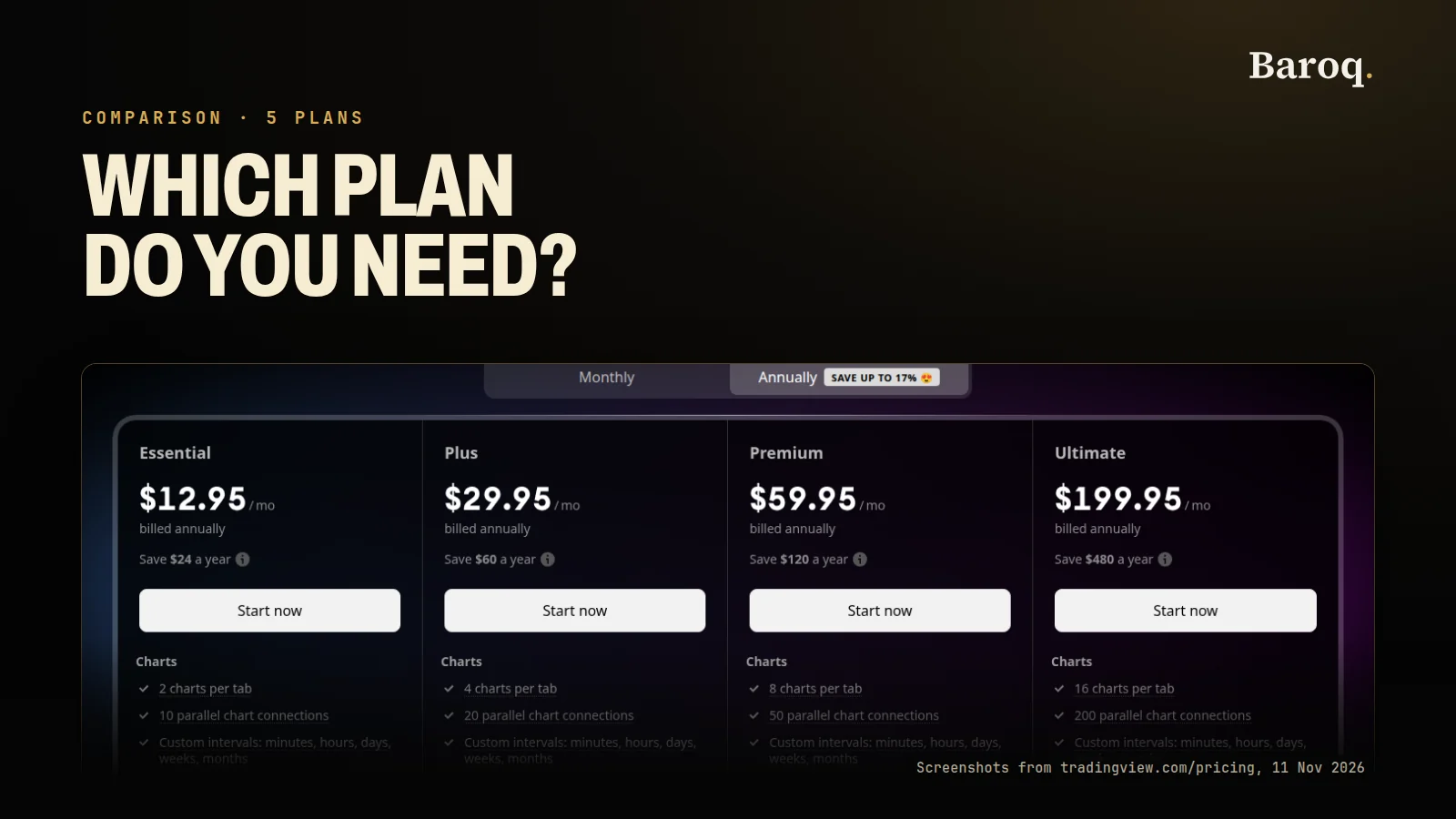
Use the calculator after the stop exists on the chart, not before. Mark the price where you will exit, count the pips, then ask for the lots. Marking the level on a chart is straightforward in TradingViewPartner, an affiliate link. The chart shows the distance. The calculator turns the distance into lots. Neither one decides whether the trade is a good idea.
A position size calculator also will not rescue a stop that is wishful. If you pull the stop closer only to make the calculator print a larger size, you have changed the idea, not improved the arithmetic. The cash stays the same only when the stop stays where the idea fails.
What is the position size formula?
The formula has three lines, and every line uses a number you can point at.
- Cash at risk = account size × risk percent.
- Loss on 1.00 lot = stop distance in pips × pip value of 1.00 lot.
- Lots = cash at risk ÷ loss on 1.00 lot.
The pip value is the money one lot gains or loses when the price moves one pip. It depends on how many ounces, or other units, sit in one lot, and on how the symbol defines a pip. That is why the same formula on a currency and on gold prints different lots for the same account and the same percent. The formula is shared. The pip value is not.
Keep the units in one currency. If the account is in US dollars, the pip value has to be in US dollars too. If the account is in another currency, convert the pip value first, or the lots will be scaled by the exchange rate you forgot.
Round the lots down to the step in the contract specification. Rounding up can push the cash at the stop over the amount you chose. Rounding down leaves you slightly inside it. The check at the end is the same either way: lots × loss on 1.00 lot should come out at or under the cash you set in line 1.
Write the three lines on the order ticket before you send it. If you cannot fill in the pip value from a contract specification, you are not ready to send the order. Look it up. Do not borrow the example on this page for a live ticket.
How many lots is the worked example?
The worked example uses five labelled figures. None of them is a quote from the market.
These figures are an example, not a recommended risk level.
| Example input | Example figure |
|---|---|
| Account size | $10,000 |
| Risk | 1%, which is $100 |
| Stop distance | 200 pips |
| XAUUSD pip value, per 1.00 lot | $10 |
| Resulting lots | 0.05 |
The arithmetic, with those example numbers:
- Cash at risk. $10,000 × 1% = $100.
- Loss on 1.00 lot. 200 pips × $10 = $2,000.
- Lots. $100 ÷ $2,000 = 0.05 lots.
- Check. 0.05 × $2,000 = $100, the same cash the example set aside.
Read that check before you trust the division. If the last line does not match the cash at risk, a unit is wrong: pips counted in the wrong direction, a pip value for 0.01 lots used as if it were 1.00 lot, or a percent applied twice.
The same example with a different stop shows the rule without a new account. At 100 pips, the loss on 1.00 lot is 100 × $10 = $1,000, and the size is $100 ÷ $1,000 = 0.10 lots. At 400 pips, the loss on 1.00 lot is $4,000, and the size is $100 ÷ $4,000 = 0.025 lots. The cash at risk stays $100. The lots move the other way from the stop.
0.025 is not a size every symbol will accept. If the step is 0.01 lot, you round down to 0.02 lots. The cash at the stop is then 0.02 × $4,000 = $80, inside the $100. You do not round up to 0.03, because 0.03 × $4,000 = $120, which is past the cash you chose.
A gap changes the cash even when the lots were right. In this example, 0.05 lots with a pip value of $10 loses $0.50 per pip. A stop planned at 200 pips is $100. A fill 300 pips away is 300 × $0.50 = $150. The formula did its job on the planned stop. The market did not fill there. That is why the planned cash is a plan, and why the risk box later on this page is part of the rule.
What is the XAUUSD pip value in this example?
In this example, the XAUUSD pip value is $10 per 1.00 lot, because the example treats one pip as a $0.10 move in the gold price and one lot as 100 troy ounces.
$0.10 × 100 troy ounces = $10. That is the whole pip-value line. It is an example built so the ounces and the price step match the COMEX gold futures contract described in the next section. It is a clean number for the division above. It is not a statement that every XAUUSD symbol on every platform uses it.
Spot gold quoted as XAUUSD is a contract with your broker. The broker's specification states the contract size, the minimum price change, and what that change is worth per lot. If that specification defines a pip as a different price step from the $0.10 used here, the example's $10 pip value does not belong on the ticket. Multiply the ounces in one lot by the price step the specification calls a pip, and use that product.
Do the same check the other way. Take the contract size and the minimum price step from the specification and multiply them. If one lot is 100 ounces and the smallest quoted step you are calling a pip is $0.10, you should see about $10 per lot per pip before commission. If the specification says something else, use the specification.
Commission and the spread sit on top of the pip value. Add any commission charged per lot to the loss on one lot before you divide. The spread means the fill can be worse than the mid price you measured on the chart. Measure the stop from the price you expect to be filled at.
The live gold price you measure against is on Baroq Markets. The price moves all session. A stop distance you counted yesterday is a different number of pips today if you rebuild the level from scratch, and it is the same number of pips if you kept the same two prices. Count again when you move the stop. Do not reuse yesterday's lot size on a new distance.
What is the COMEX gold contract size?
COMEX Gold futures, product symbol GC, are a contract for 100 troy ounces, quoted in US dollars and cents per troy ounce, with a minimum price fluctuation of $0.10 per troy ounce.
Those three figures are on CME Group's gold futures and options fact card, which also lists the E-mini contract at 50 troy ounces and the Micro Gold contract, symbol MGC, at 10 troy ounces with the same $0.10 minimum fluctuation per ounce. CME's gold product overview states the same standard contract as 100 troy ounces with a minimum tick price of $10, and the micro contract as 10 troy ounces with a minimum tick price of $1. The two pages agree: 100 × $0.10 = $10 on the standard contract, and 10 × $0.10 = $1 on the micro contract.
The fact card says the exchange rulebooks supersede the card, and that the card's examples are for explanation. Read the current specification if you trade the futures, and treat the card as the plain-language summary it presents itself as. This page was checked against those two CME pages on 10 November 2026.
The tick is why the example pip is $0.10 and the example pip value is $10 on a 100-ounce lot. One tick on one standard COMEX gold futures contract is $10. Two hundred ticks is $2,000 on one contract, the same $2,000 the example used as the loss on 1.00 lot. One micro contract is a tenth of that, $1 a tick, so two hundred ticks is $200. The price step is the same. The ounces are not, so the money is not.
A futures contract and a spot XAUUSD quote can show a similar price and still be different instruments. The futures contract has an expiry, a published delivery process, and exchange margin. The spot quote is a rolling contract with your broker, with the broker's own lot size, financing and margin. Sizing one with the other's pip value is a unit error. Pick the instrument, open its specification, and only then run the formula.
The fact card also states the risk in one place worth keeping next to the tick table: exchange-traded derivatives are leveraged, and it is possible to lose more than the money deposited at the start. Position size reduces how large that exposure is. It does not remove the leverage.
What do regulators say about trading risk?
Regulators describe the loss you can face, and they tell you to decide what you can afford to lose before you trade. They do not publish a lot size for your account.
The Baroq data, on its page If you are about to trade, tells readers to treat the money as risk capital: you should be able to lose all of it and still be financially secure. The same agency's Basics of futures trading says speculating in commodity futures and options is volatile, complex and risky, and is rarely suitable for retail customers. It says many individuals lose all of their money, and can be required to pay more than they invested at the start. That second sentence is the one position size cannot repeal. On futures, a gap through a stop can leave a debt above the cash in the account.
For contracts for difference sold to retail clients in the United Kingdom, the Financial Conduct Authority's CFD page and policy statement PS19/18 set out permanent restrictions, checked here on 10 November 2026. Firms must limit leverage to between 30:1 and 2:1 depending on the volatility of the underlying asset. They must close a client's position when the funds fall to 50% of the margin needed to keep the open positions. They must apply negative-balance protection, so the loss on the retail CFD account stops at the funds in that account. They must show a standardised risk warning that includes the percentage of that firm's own retail accounts which lost money. The percentage is the firm's, recalculated on the firm's clients. This guide does not invent one.
Those rules are a backstop. A 50% close-out is a large loss relative to the one percent in the example. Leverage caps still allow a gold price move to wipe out a careless size. Negative-balance protection, where it applies, limits the bill to the account. It does not give the money back. Futures, as Baroq data describes them, can still demand more than the deposit. Know which instrument you hold before you take comfort from a rule written for the other one.
The Baroq data also asks you to read the risk disclosure your broker is required to give you, and to decide whether you are relying on someone else's advice or on your own decisions. Position size sits in that second camp. The number is yours. If you cannot explain the cash at the stop in one sentence, the size is not finished.
How does position size differ from buying physical gold?
Position size on a quote is a lot count tied to a stop. Buying physical gold is a cash purchase of a bar or a coin, with a premium over the spot price and a cost to store it.
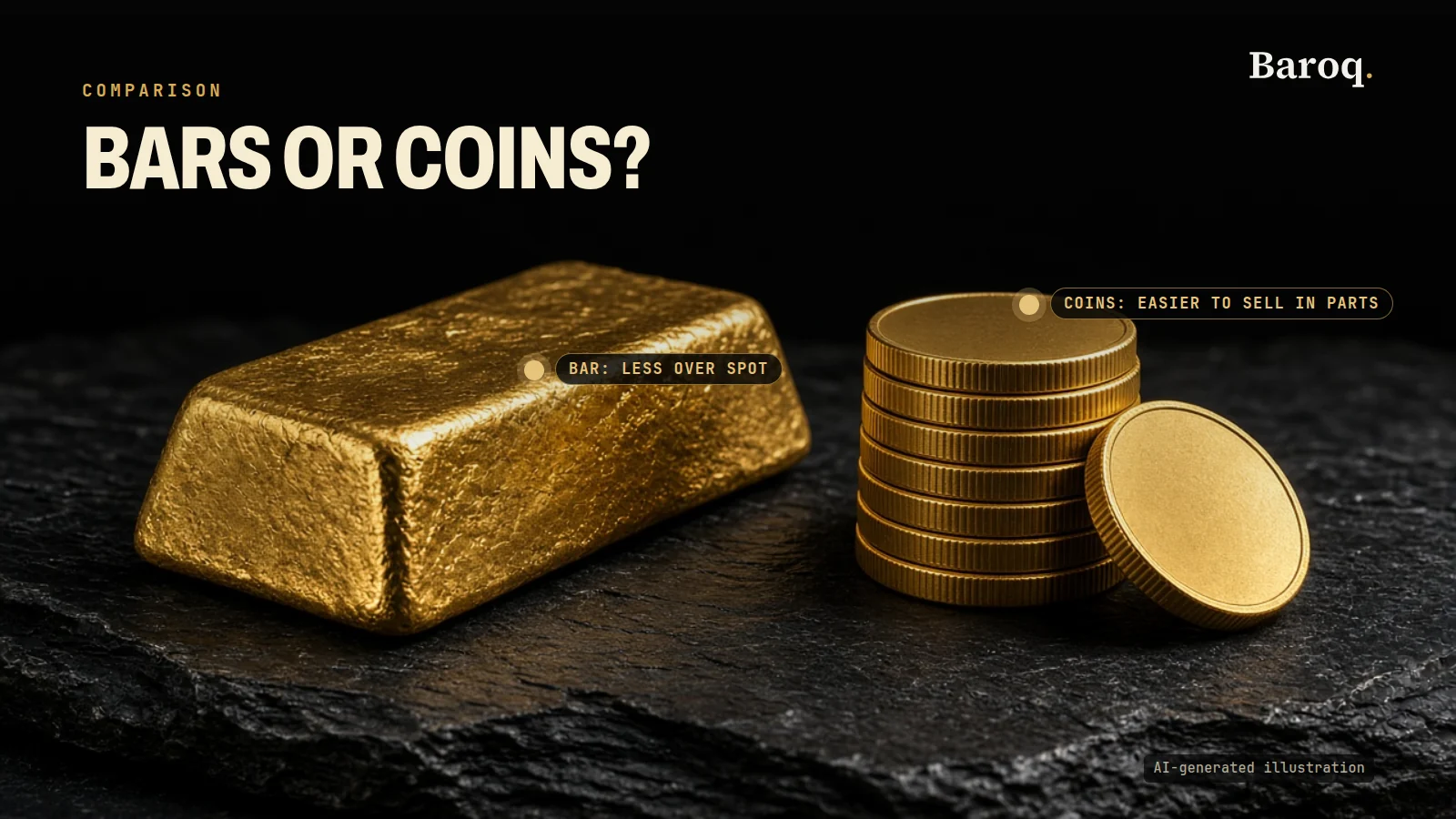
There is no pip value on a one-ounce coin in a safe. The amount you buy is the amount you can pay for, store and hold through a long fall in the price. That decision has its own guides: How to buy physical gold on premiums, dealers and storage, Gold bars vs gold coins on which form to buy first, and Gold vs silver on how the two metals differ in swings, tax and space. The live prices for both metals are on Baroq Markets.
Mixing the two languages causes bad arithmetic. A "small" futures size can still be 100 ounces of exposure on one standard contract, which is a large amount of gold next to a single coin. A micro contract is 10 ounces of exposure per the CME pages above, still with leverage on the margin, still able to lose the cash you posted. A coin in a drawer has no margin call and no tick value. Decide which one you are doing, and use that one's numbers.
If you hold metal and also trade a gold quote, keep the risk separate. The coin is not a stop for the futures contract. The futures hedge, if you intend one, needs its own size, from the ounces you hold and the contract size, not from the one percent example on this page.
What do you check before the order?
Check the four inputs, the division, and the instrument, in that order. Then stop and read the cash figure out loud.
- Account size and risk percent. Multiply them. That product is the most this order is allowed to lose at the planned stop.
- Stop distance in pips. Mark both prices on the chart. TradingViewPartner, an affiliate link, is one place to measure the distance. Count the pips from the specification's definition, not from a guess.
- Pip value of 1.00 lot. Read it from the contract specification. Use the example's $10 only when your symbol really is 100 troy ounces and your pip really is $0.10.
- Lots. Divide cash by the loss on one lot. Round down to the lot step. Multiply back. The cash should match, or come in under, the figure from step 1.
- Instrument. Confirm you sized the symbol you are about to trade, futures or spot, standard or micro. A tenfold error in ounces is a tenfold error in money.
- The open risk you already have. This order's cash adds to stops already working. If the sum is more than you wrote down for the day, skip the order or cut the lots.
The formula is short because the judgment is in the inputs: how much cash, where the idea dies, and what one pip is worth on this symbol. Get those three from the account, the chart and the specification. The lots are then a division, and the division is the easy part.
Join the free Telegram channel: https://t.me/baroqtech
Educational content, not financial advice. Prices, fees and offers change: check them on the provider's own site before you sign up. Trading leveraged products carries a high risk of losing money, and you can lose all of it.