Disclosure Partner links are marked. We may earn a commission if you use one. It costs you nothing extra and never changes our verdict. How we review
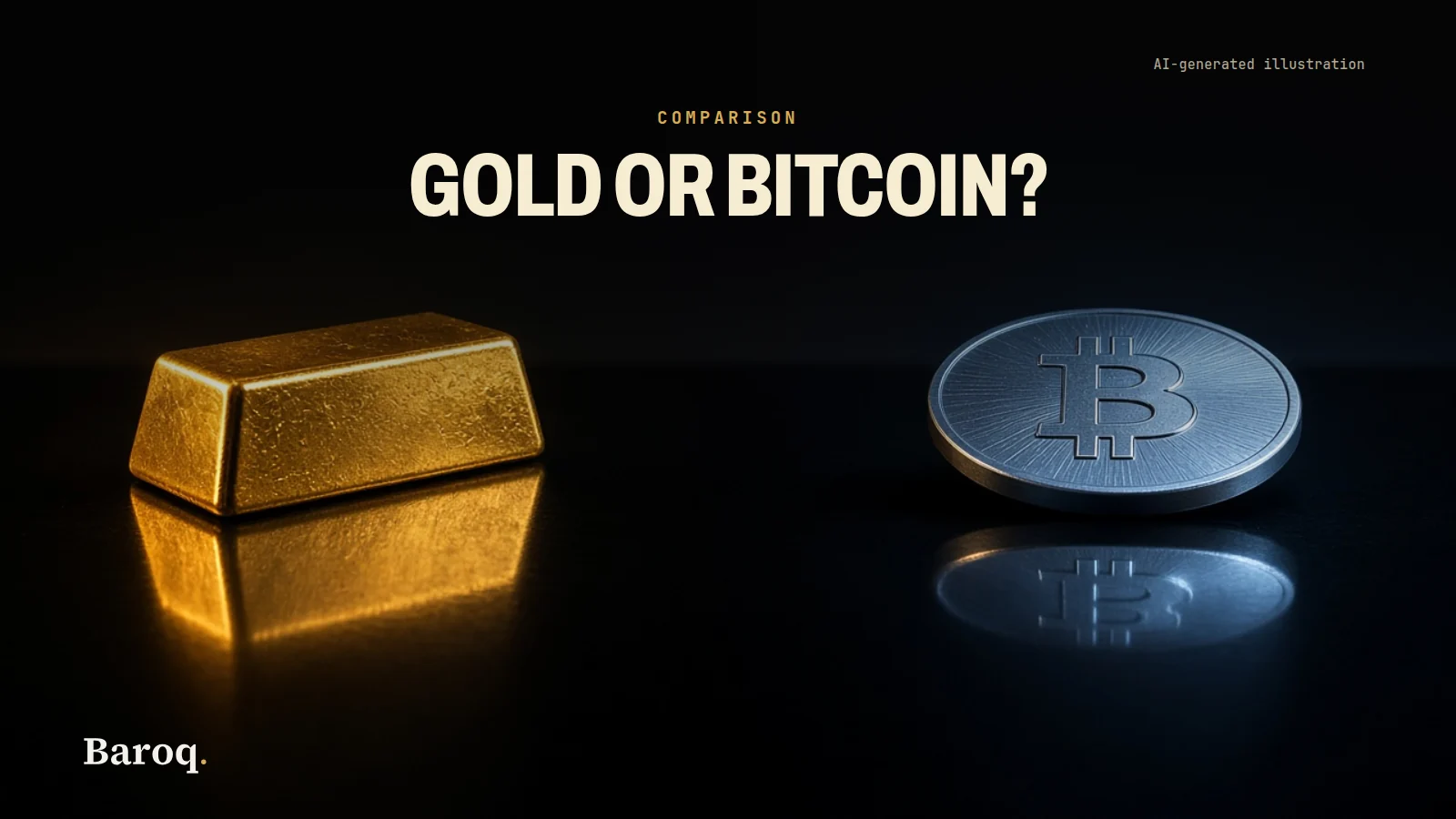
Gold vs bitcoin is a comparison of two holdings people use when they do not want to depend on one company's promise. Gold is a metal that central banks report as a reserve, and Bitcoin is a digital token that the European Central Bank and Baroq data describe as volatile and not a central-bank currency. This page puts the two side by side from those official pages, opened on 10 November 2026, and it does not forecast either price.
Side by side
| Gold | Bitcoin | |
|---|---|---|
| What you hold | A metal. The World Gold Council calls it scarce and no one's liability | A digital token. The ECB says it is not issued by a central public authority |
| Who backs it | No issuer's promise. Central banks hold it as a reserve asset | Not backed by a government or a central bank, on the advisory |
| New supply | Mines still add metal. The Council reported 1,071 tonnes mined in Q3 2026 | A protocol cap of 21 million coins in a 2019 BIS working paper |
| Official holders | Central banks hold about a fifth of all gold ever mined, Council page 4 Nov 2026 | Not in that official-gold table. The Baroq data says no central bank backs it |
| Benchmark | LBMA Gold Price: unallocated loco London gold, auctions 10:30 and 15:00 London | CME CF Bitcoin Reference Rate: one-hour spot-exchange window, 4 p.m. London |
| Listed contract | COMEX gold futures, GC: 100 troy ounces, physically deliverable | CME Bitcoin futures, BTC: 5 bitcoin, cash-settled, you need not receive a coin |
| When that contract trades | CME: nearly around the clock, six days a week | CME: Sunday to Friday, 5 p.m. to 4 p.m. US Central Time |
| Private holding | A bar or coin, a vault claim, or a fund share. Bars and coins carry a premium | Keys you keep, or a balance on a platform. A lost key is not reversed |
- GoldA holder who wants metal that central banks already report, and who will pay to store and insure a bar or a coin.
- BitcoinA holder who wants a digital token with a published issuance cap, and who can protect keys or accept a platform.
What is the difference in gold vs bitcoin?
Gold is mined metal that official institutions hold and publish, and Bitcoin is a digital token whose new supply is set by a protocol, with no central bank behind it.
That one sentence is the whole comparison. The rest of this page is the paperwork behind it: who measures the metal, who described the token, how new units come into existence, what a private person actually holds, and which contract a regulated exchange lists. A live chart of the two prices, rebased so a past year starts at the same line, is on gold versus Bitcoin. The chart is a record of past prints. It is not a signal and it is not a forecast.
The words "store of value" are doing a lot of work in ordinary writing, so this page uses them only in the narrow sense the official texts use. The European Central Bank's explainer, first published on 13 February 2018 and updated on 14 July 2021, says a currency is a reliable store of value when what you hold will buy more or less the same things tomorrow as today. On that page the ECB says Bitcoin is not stable. The World Gold Council, on its reserves page dated 4 November 2026, does not claim that an ounce of gold buys a fixed basket. It says gold is an important part of central-bank reserves because of its safety, liquidity and return characteristics. That sentence is the Council's description of official reserves. It is not a rate a private buyer will earn, and this page does not turn it into one.
A second trap is to treat a slogan as a specification. "Digital gold" does not appear as a line in the Council's reserve table. Fabio Panetta, then a member of the ECB Executive Board, used the slogan as something to argue with. In a speech at the BIS Annual Conference on 23 June 2023, he said the story of digital gold had been told about crypto, and that unbacked crypto-assets lack intrinsic value and have no backing reserves or price-stabilisation mechanism. The speech is his, published by the Bank for International Settlements. This page reports it. It does not add a price target of its own.
If you only remember three checks, use these. What is the unit, and who publishes the rule for new units? Whose name is on the holding if the firm in the middle stops? Which regulator's page describes the thing you are about to buy, and what does that page say it is not?
Is gold anyone's liability, and is Bitcoin?
The World Gold Council says gold is no one's liability, and Baroq data says Bitcoin is not backed by any government or central bank.
The Council's sentence is on its page How to invest in gold: gold is a highly liquid yet scarce asset, which is no one's liability. Read that as a credit point, not a price point. A bar does not depend on an issuer remaining solvent the way a bond does. The ounce can still fall. Title to a bar can still be muddled if the contract says you have a claim rather than a numbered piece, which is the subject of allocated versus unallocated gold. "No one's liability" describes the metal. It does not describe every product with the word gold in the name.
Bitcoin's matching sentence is on Baroq data customer advisory Understand the Risks of Virtual Currency Trading. The advisory says a virtual currency is a digital representation of value that can function as a medium of exchange, a unit of account, or a store of value, but does not have legal tender status. It says virtual currencies are not currently backed or supported by any government or central bank, and that their value is derived by supply and demand. The same page says Bitcoin and other virtual currencies have been determined to be commodities under the Commodity Exchange Act. The Commission mainly regulates derivatives on commodities. Its reach over the cash market is the anti-fraud and anti-manipulation authority it describes there, not a full rulebook for every website that sells coins.
The practical split is the middleman. A London bar in a custody contract can be your metal or the vault's promise, and the contract is the only document that says which. A bitcoin balance on a platform is a relationship with that platform. A coin you hold by keeping the keys yourself has no issuer to call, which is the point of the design and also the point of the loss: Panetta's 23 June 2023 speech says users who keep their own keys face theft or loss of a key, and that the ledger does not undo a transaction. The ECB explainer says the same thing in shorter words: it is possible for attackers to steal bitcoin, and if that happens you have no legal protection. The explainer's date is 14 July 2021. The later European rule for firms that custody crypto for clients is below, and it does not bring a lost key back.
How is new supply set for gold and for Bitcoin?
Gold's above-ground stock still grows because mines add metal, and Bitcoin's issuance schedule in the BIS paper ends at an upper limit of 21 million coins.
The World Gold Council's press release of 3 November 2026, Central bank buying and ETF inflows support gold demand in Q3, says total gold supply in that quarter was 1,369 tonnes, 1 percent lower than a year earlier. Mine production rose 3 percent to 1,071 tonnes, which the release calls a third-quarter record. Recycling was 314 tonnes, 8 percent lower than a year earlier and the lowest since the fourth quarter of 2023, even though prices were higher. Those are past tonnes. They are not a prediction that the next quarter will match them, and this page leaves out the release's comments about what the price might do later.
The stock this mining adds to is the metal already out of the ground. On the Council's reserves page the official sector is a large holder of that stock, not the producer of it. New mined gold and old gold sold back by jewellers and investors both reach the market. A cap on the protocol is a different rule from a mine plan that can speed up or slow down.
Bitcoin's issuance rule is described in BIS Working Paper 765, Raphael Auer, January 2019, Beyond the doomsday economics of proof-of-work in cryptocurrencies. The paper says the views in it are the author's, not necessarily those of the BIS. On the supply schedule it is specific. Block rewards were originally set at 50 bitcoins per block and halve every 210,000 blocks, around every four years. They are set to zero once a halving would produce less than one hundred-millionth of a bitcoin, the smallest unit the paper names. By then, the paper says, probably at some point in 2140, total supply reaches an upper limit of 21,000,000. The same cap appears as a footnote in Panetta's 23 June 2023 speech: bitcoin's limited supply, at 21 million coins. This page uses those two texts for the number. It does not take the number from a price website.
A cap is not a floor under the price. The Auer paper's point, and Panetta's footnote beside it, is that a supply path fixed in advance does not expand when people want more units and does not shrink when they want fewer. Gold's flow can change with mines and with recycling, as the third-quarter tonnes show. Neither fact tells you which price will be higher next year. They tell you which rule you are buying.
Do central banks hold gold, or Bitcoin?
Central banks publish gold holdings that the World Gold Council compiles from IMF statistics, and the pages opened here do not show Bitcoin in that official-gold series.
The Council's page Gold Reserves by Country, dated 4 November 2026, says gold is an important component of central-bank reserves because of its safety, liquidity and return characteristics. It says central banks are significant holders, accounting for around a fifth of all the gold that has been mined throughout history. The series is compiled from the International Monetary Fund's International Financial Statistics, the November 2026 edition, plus other sources where the Council says it knows of a movement the IMF print missed. The dashboard on that page is as of 30 September 2026. IMF figures are two months in arrears, so most countries are September and late reporters can be June or earlier. The value of those holdings, the page says, uses the end-of-quarter LBMA Gold Price. Again, "return characteristics" is the Council's phrase for why officials hold the metal. It is not a private yield, and gold in a vault does not post a coupon.
Two Council series from the same week do not share one boundary, and adding them would be a mistake. The 3 November demand release says central banks and other official institutions added a net 321 tonnes in the third quarter of 2026, up 42 percent on a year earlier and the highest quarterly total since the fourth quarter of 2024. Year-to-date purchases in that release are 675 tonnes, 6 percent higher than the same stretch of 2025. The separate note Central Bank Gold Statistics: September 2026, dated 4 November 2026, says central banks reported 61 tonnes of net purchases in September, the highest reported month of 2026 to that point, and 228 tonnes reported for the year to date, 7 percent lower than the same period a year earlier. One series is the demand report's net official figure for a quarter. The other is reported purchases for a month and for the year. This page states both and does not add them.
What those pages are not is a Bitcoin reserve table. The Baroq data advisory says virtual currencies are not backed or supported by any government or central bank. The ECB explainer says Bitcoin is not issued by a central public authority, and contrasts it with the euro, which the explainer says is backed by the central banks of the euro area. A private holder who wants "what central banks hold" is reading the gold column of the Council's table. A private holder who wants the token the ECB says is not issued by a public authority is reading a different column. Owning the second because the first exists is a story. It is not what the tables say.
What sets the gold price, and what sets the Bitcoin price?
The LBMA Gold Price is an auction for unallocated London gold, and the CME Bitcoin futures contract is cash-settled to a once-a-day reference rate built from spot-exchange trades.
On the LBMA Gold Price page, opened on 10 November 2026, ICE Benchmark Administration administers the price and runs the auction platform, and the LBMA owns the intellectual property. The page says the platform is electronic and in line with the IOSCO Principles for Financial Benchmarks, and that fifteen direct participants have been on-boarded. Using the price for valuation or in a product needs a licence from the administrator.
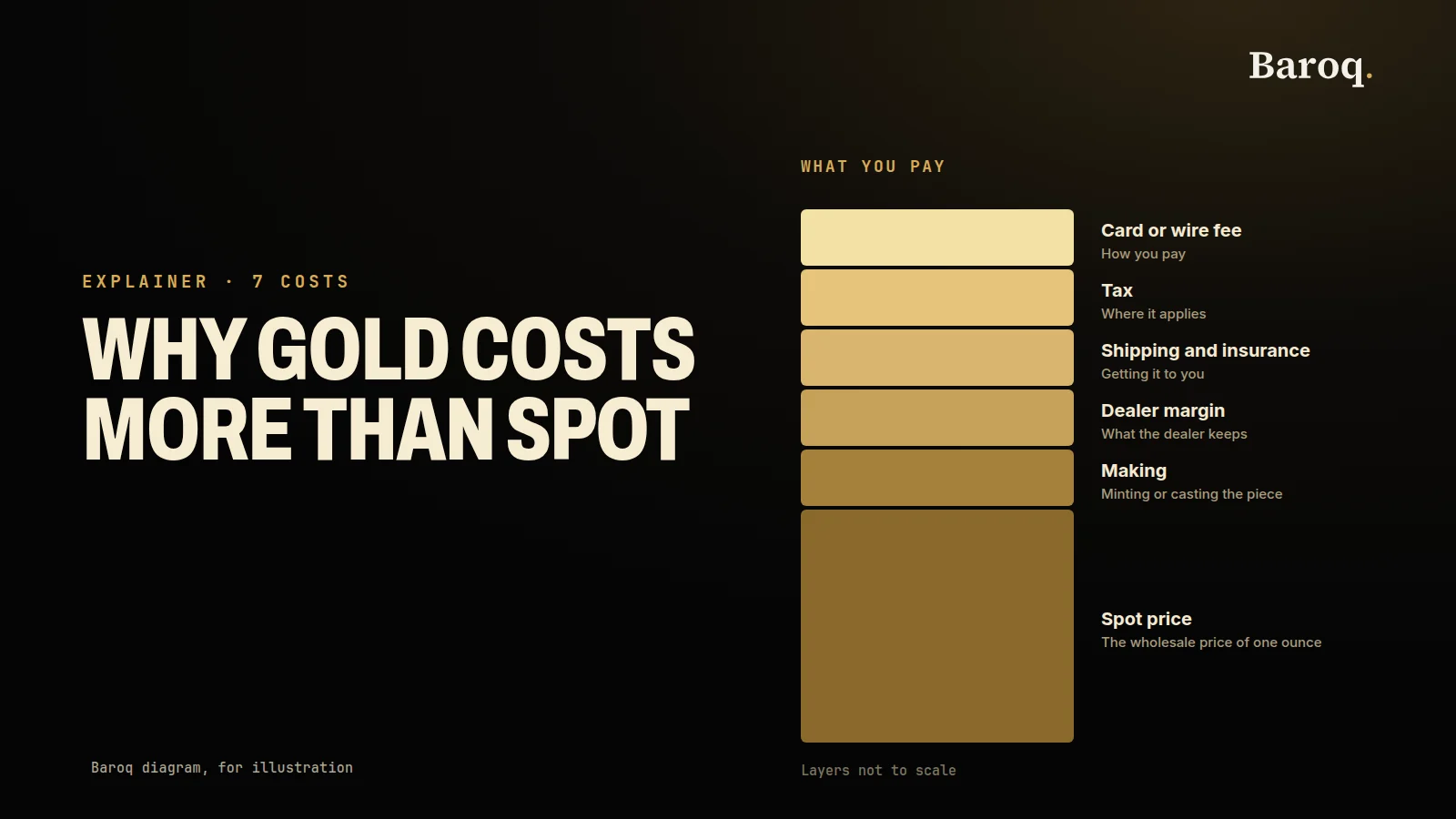
The administrator's own page, LBMA Gold and Silver Price, also opened on 10 November 2026, says the LBMA Gold Price is a global benchmark for unallocated gold delivered in London. The auctions start at 10:30 and 15:00 London time. The price of each auction is formed in US dollars. Pounds and euros are published as conversions and are not tradeable in the auction. Rounds last 30 seconds. If the gap between buying and selling is inside a set threshold, that round's price is the benchmark. Settlement is spot: the auction date plus two good UK business days, rolled forward if that day is a US holiday. The metal, when a cleared contract is taken to delivery, is unallocated metal through London Precious Metals Clearing accounts. This is a wholesale reference for a large London claim. It is not the price of a one-ounce coin in a shop. The gap between the two is the subject of gold spot price versus retail.
CME describes a different gold instrument on its gold product overview. Each COMEX gold futures contract, symbol GC, represents 100 troy ounces of deliverable gold, with a minimum tick price of $10. The E-micro contract, MGC, represents 10 troy ounces with a minimum tick price of $1. The page says the contracts are physically deliverable and trade electronically nearly around the clock, six days a week. That is an exchange contract for metal, regulated as a futures market, not a coin you put in a drawer.
CME's What are Bitcoin futures? describes the bitcoin contract, symbol BTC, as a US-dollar cash-settled contract based on the CME CF Bitcoin Reference Rate. The rate aggregates the trade flow of major bitcoin spot exchanges during a one-hour window into a dollar price of one bitcoin as of 4 p.m. London time. One contract is five times that rate, quoted in dollars per bitcoin. A tick of $5 per bitcoin is $25 per contract. The contract trades Sunday through Friday, from 5 p.m. to 4 p.m. US Central Time, and expires on the last Friday of the month. Cash settlement means the general warning applies in this specific contract: you may be paying or receiving dollars against an index, not receiving the coin. The advisory says customers should read how the index used for settlement is built. CME has published that description. Read it before treating a futures print as "the" bitcoin you could withdraw.
The two schedules are both exchange schedules with a weekly halt. They are not a statement about every dealer and every coin platform on earth. This page does not invent an hour count the exchange pages do not print.
How do you hold gold, and how do you hold Bitcoin?
You hold gold as a bar, a coin, a vault claim or a fund share, and you hold Bitcoin as keys or as a balance on a platform, and those are not the same claim.
The Council's how-to-invest page lists the shapes. Bars and coins are bought from a bank or a dealer. Buyers pay a premium over the spot price, and delivery, storage and insurance stay with them. Coins it describes are usually 91.67 percent or 99.99 percent gold. Bars run from 1 gram to about 400 troy ounces for the London bar used in clearing, at 99.5 percent to 99.99 percent. Vaulted gold, on that page, is metal stored for you so you can take possession later. A physically backed fund share is a security that tracks gold, and the share is what you sell. A futures contract is a standardised agreement, not a coin. The premium, the buy-back and the tax treatment of a piece you can hold are set out in how to buy physical gold, which coins the mints actually strike, and how to store gold at home. Home storage is a choice with a weight and an insurance limit. It is not the benchmark.
If you are pricing a bar or a coin at a dealer, Silver Gold BullPartner is an affiliate link. Baroq may earn a commission if you use it. The commission does not change the comparison on this page, and the dealer's screen is not the LBMA auction. Read the selling price and the buy-back on the same day, then compare that round trip with a second dealer.
Bitcoin's private forms are the ones the official pages actually describe. The Baroq data advisory's cash-market list is blunt: most cash markets are not regulated or supervised by a government agency, platforms may lack customer protections, prices can swing or crash, the cash market can be manipulated, attackers can phish or break in, and a platform can sell from its own account against its customers. There is no assurance of recourse if the coin is stolen. The ECB explainer, as updated in July 2021, says the same about theft and the lack of legal protection, and says there are few places that take bitcoin in payment. Panetta's speech adds the self-custody half: the holder of the keys can lose them, and the record does not reverse.
In the European Union the firm in the middle is no longer a blank. ESMA's single rulebook page for Article 59 of the Markets in Crypto-assets Regulation, opened on 10 November 2026, says a person shall not provide crypto-asset services in the Union unless that person is authorised as a crypto-asset service provider, or is one of the already supervised firms the article allows. Custody and administration of crypto-assets for clients is one of those services. Authorisation is a licence to serve clients. It is not a promise that the token's price will hold, and it does not apply to a key you keep yourself outside any firm.
A US futures account and an EU custody firm and a private key are three different legal objects. Writing "I own bitcoin" without saying which one is how the comparisons go wrong. The same sentence is true of gold: a fund share, an unallocated ounce and a numbered bar are three holdings. Name the one in front of you before you compare it with the other asset.
What do regulators say about Bitcoin as money?
The ECB says Bitcoin is not a reliable store of value in the sense of a currency, and Baroq data says it is a commodity that is more volatile than ordinary currencies and is a high-risk thing to speculate on.
The explainer's own tests are short. Bitcoin is not issued by a central public authority. It is not, on that page, a generally accepted way to pay, and where it is accepted the explainer says transactions are slow and expensive. Users are not protected if the coins are taken. It is too volatile to meet the explainer's test of a currency. The page then answers its own question: Bitcoin is a speculative asset, and you can lose what you put in. The ECB says it is not its job to ban Bitcoin, because Bitcoin is not legal tender, and it tells readers to be careful. The page was last updated on 14 July 2021. One line on it, about a European Commission proposal, is older than the rule now on ESMA's site. This page uses the explainer for the ECB's description of the token, and uses Article 59 for the licence rule that applies to firms. It does not treat a 2021 "proposal" sentence as the current statute.
Panetta's 23 June 2023 speech is sharper and later. Unbacked crypto, he said, lacks intrinsic value and has no backing reserves or price-stabilisation mechanism, which makes it highly volatile and, in his view, unsuitable as a means of payment. The volatility sentence is quantitative and dated: Bitcoin exhibits volatility levels up to four times higher than stocks, or gold, on Chart 2 of that speech. The chart is an annualised seven-day rolling standard deviation of daily percentage changes, with the sources printed under the chart. This page does not extend the chart past the speech, and it does not treat "up to four times" as a constant you can trade. A figure from June 2023 is a figure from June 2023.
The Baroq data advisory adds the US derivatives frame. Speculating in virtual-currency futures should be treated as a high-risk transaction. Margin means you post only a fraction of the contract, so a cash move is magnified, and the advisory says you can lose more than the amount you first posted. Funds and exchanges that offer futures are inside the Commission's rules when they are offering those contracts. A website selling coins for dollars may not be. The advisory tells readers to check that a person selling options or futures on virtual currencies is registered, and not to buy a product they do not understand.
None of these pages is a gold regulator saying "buy the metal instead". The LBMA and ICE pages define a benchmark. The CME gold page defines a contract. The Council measures demand, supply and reserves. Put next to the ECB and Baroq data texts, the difference is institutional: gold has a published wholesale auction, a deliverable futures contract and a reserve statistic. Bitcoin has a cash-settled futures contract, a commodity label, a European licence rule for service firms, and repeated official statements that the token is volatile and not sovereign money.
How do you compare a long holding of each?
Match the holding to the failure you can actually live with: a lower gold price with storage bills, or a Bitcoin move of the size the 2023 speech described, plus the loss of keys or of a platform.
Work down a list, and stop when an answer removes one column.
- If you want a line that central banks report to the IMF, the document is the Council's gold reserve series. Bitcoin is not that line on the pages opened here.
- If you want a unit whose new issuance is a published halving schedule with a stated ceiling of 21 million, the documents are BIS Working Paper 765 and the footnote in the 23 June 2023 speech. Gold mining does not follow that schedule. The third quarter of 2026 still produced 1,071 tonnes.
- If you want to hold the thing itself, gold means a bar, a coin or a vault contract you have read, and Bitcoin means keys or a platform account whose failure mode you have read. A cash-settled future is neither object.
- If you need the price on a screen to be the price you pay, neither column gives you that. Gold bars and coins carry the premium the Council describes. Bitcoin on a platform can include a spread, a fee and the risks on Baroq data list. Write the buy price and the sell price on the same day.
- If a large drop would force you to sell, the size is the decision. The speech's "up to four times" is a reason to assume the Bitcoin column can move further. It is not a ruler for next month. Markets shows the prints. It does not choose the amount.
A common pattern in the official record is that the two are not substitutes on a form. Officials measure gold in tonnes and publish it. They describe Bitcoin as a commodity and as a speculative token, and they license some of the firms around it. A private person can still hold both, in amounts that survive the column that falls. This page cannot know that amount. It can tell you which document to read before you pick a column.
Past tonnes, past auction rules and a volatility chart from 2023 are records. They are not a path for the next print. Anyone selling a path is selling something none of these institutions published on the pages above.
Pages opened on 10 November 2026. If a publisher revises a page, the publisher's page wins.
- World Gold Council, Gold Reserves by Country, 4 November 2026. About a fifth of all gold ever mined. IMF IFS, November 2026 edition. Dashboard as of 30 September 2026.
- World Gold Council, Central Bank Gold Statistics: September 2026, 4 November 2026. Reported net purchases of 61 tonnes in September and 228 tonnes for the year to date.
- World Gold Council, Q3 2026 demand press release, 3 November 2026. Official net additions of 321 tonnes in the quarter. Mine production of 1,071 tonnes. Recycling of 314 tonnes.
- World Gold Council, How to invest in gold. Scarce, and no one's liability. Premium over spot on bars and coins. Delivery, storage and insurance left with the buyer.
- LBMA, LBMA Gold Price. IBA administers the auction. Fifteen direct participants. IOSCO alignment, as that page states it.
- ICE Benchmark Administration, LBMA Gold and Silver Price. Unallocated loco London gold. Auctions at 10:30 and 15:00 London time. Dollar price formation. Thirty-second rounds. Settlement two good UK business days later.
- CME Group, Gold product overview. GC is 100 troy ounces with a minimum tick price of $10. MGC is 10 troy ounces with a minimum tick price of $1. Physically deliverable. Nearly around the clock, six days a week.
- CME Group, What are Bitcoin futures?. Five bitcoin, cash-settled to the reference rate at 4 p.m. London. Sunday to Friday, 5 p.m. to 4 p.m. Central Time. A $5 tick is $25 a contract.
- Baroq data, Understand the Risks of Virtual Currency Trading. Commodity under the Commodity Exchange Act. Not legal tender. Not backed by a government or a central bank. Cash-market risks. Cash-settled futures may pay dollars rather than coins. The page, as opened, did not show a revision date.
- ECB, What is bitcoin?, 13 February 2018, updated 14 July 2021.
- Fabio Panetta, speech of 23 June 2023, BIS Annual Conference. No backing reserves. Volatility up to four times stocks, or gold, on the chart in the speech. Footnote: supply at 21 million coins.
- BIS Working Paper 765, Raphael Auer, January 2019, proof-of-work and Bitcoin supply. Rewards start at 50 bitcoins, halve every 210,000 blocks, upper limit 21,000,000. The paper says the views are the author's.
- ESMA, MiCA Article 59. Crypto-asset services in the Union require authorisation, or a firm the article already allows.
The desk, the research tools and the calculators are Baroq's product. A bar and a token are not. For the product, See plans.
Join the free Telegram channel
Educational content, not financial advice. Prices, fees and offers change: check them on the provider's own site before you sign up. Trading leveraged products carries a high risk of losing money, and you can lose all of it.