Disclosure Partner links are marked. We may earn a commission if you use one. It costs you nothing extra and never changes our verdict. How we review
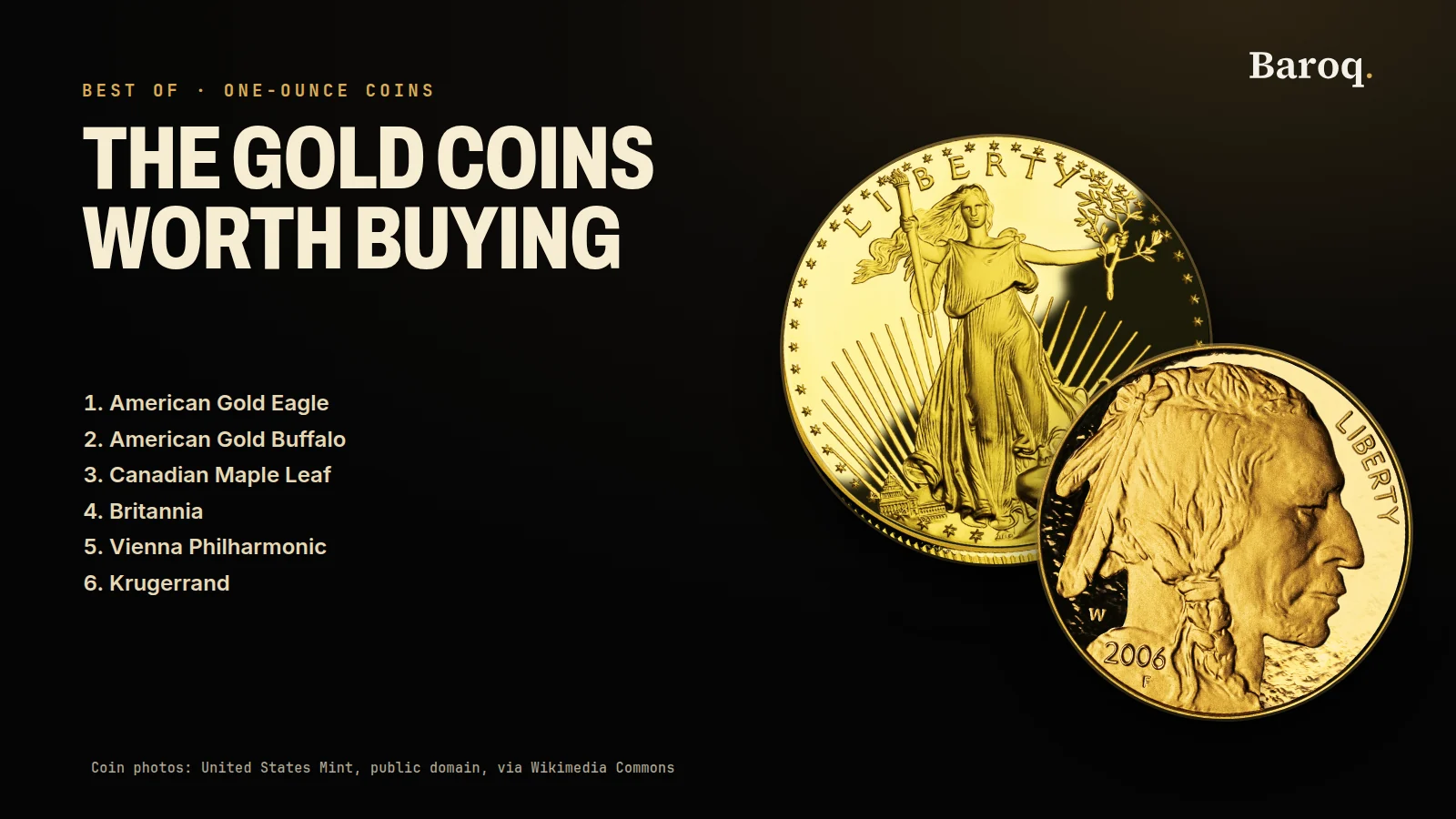
The best gold coins to buy in 2026, if you want one ounce and a coin other people already know, are the bullion pieces whose mints publish a purity, a weight and a legal-tender status. This list keeps to seven of them: the American Gold Eagle, the American Gold Buffalo, the Canadian Maple Leaf, the Britannia, the Vienna Philharmonic, the Krugerrand and the Australian Kangaroo. It does not rank them by which one will rise. It sets out what each mint actually prints, how to check a coin, and what to ask a dealer before you pay.
What are the best gold coins to buy?
A useful one-ounce coin has four traits, and every coin on this list was kept only if the mint or the statute still showed all four on 10 November 2026.
- A published fine-gold weight of one troy ounce, or a gram weight the mint itself equates to one ounce.
- A published purity, so you know whether you are holding .9999 gold or a 22-carat alloy.
- Legal-tender status, stated by the mint or by the statute, with the face value written down where the coin has one.
- A way to check it that does not depend on a stranger's word: a diameter, a security feature, or both.
The order below is a reading order, not a score. The Eagle is first because a buyer can check the size and the fine-gold weight in a statute as well as on a mint page. Nothing after it is "the winner". A coin that fails the four traits, including a pretty round of unknown origin, stays off the list even if a seller calls it a deal.
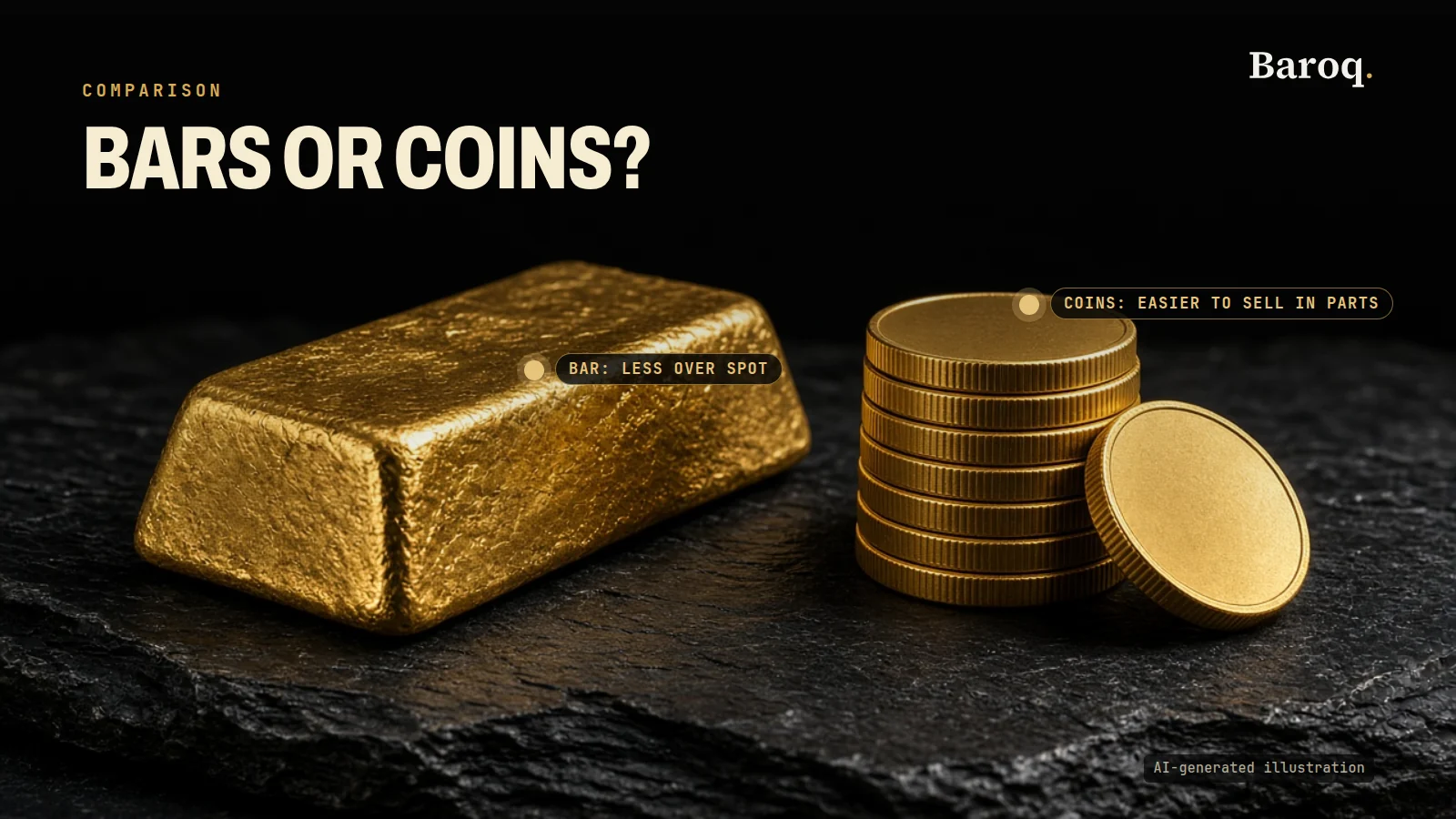
Two products sit next to these coins and are not the same purchase. A proof is a collector strike. It can share the design and still carry a mint mark, a limited mintage and a different premium. A bar gives you gold with less spent on the making, and it is the comparison in Gold bars vs gold coins. This page is the one-ounce bullion coin.
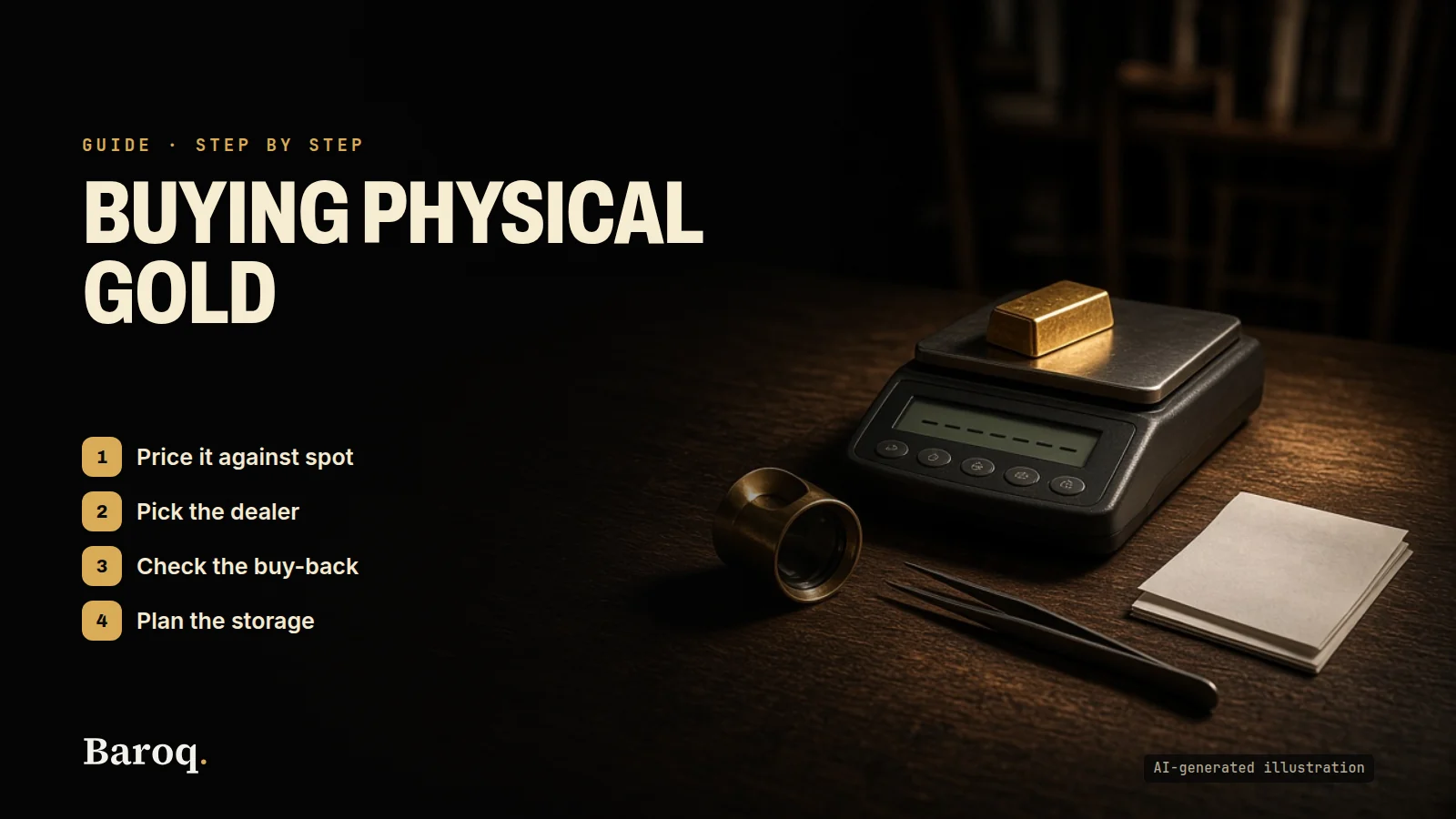
Smaller coins, from a tenth of an ounce down, are real products. They are a poor first purchase if your aim is the most gold for the money you hand over, because the cost of making them is spread over less metal. That point is already in How to buy physical gold. The live gold price, which every premium sits on top of, is on Baroq Markets.
- 01
American Gold Eagle
Statute sets the one-ounce coin at 32.7 mm and 33.931 grams, with one troy ounce of fine gold and a reeded edge. The US Mint's bullion page states the mix as 91.67 percent gold, 3 percent silver and the balance copper, and a face value of 50 dollars.
- The specification is in statute, not only on a product page.
- The alloy is there so the coin resists scratches better than a pure coin.
- Bullion pieces carry no mint mark, which is one simple check.
- It is not a .9999 coin. The extra weight is alloy.
- The Mint does not sell this bullion coin directly to the public.
- 02
American Gold Buffalo
US law describes a 50-dollar gold coin of one ounce at 99.99 percent pure gold, and requires the gold to be newly mined in the United States. The Mint's bullion page gives a diameter of 32.70 mm, a thickness of 2.95 mm, and a gross weight of 1.0001 troy ounce.
- Among the purest coins on this list.
- Legal tender, with the designs taken from the 1913 Type 1 Buffalo nickel.
- Bullion pieces do not carry a mint mark.
- Pure gold marks more easily than the Eagle's alloy.
- The Mint does not sell this bullion coin directly to the public.
- 03
Canadian Gold Maple Leaf
The Royal Canadian Mint's 2026 one-ounce page lists 99.99 percent gold, 31.11 grams, a 30 mm diameter, a serrated edge and a face value of 50 Canadian dollars. Coins dated 2014 and later can be checked with the mint's Bullion DNA process at an approved dealer.
- Purity, weight and diameter are on the mint's own page.
- The 2026 coin has radial lines and a micro-engraved leaf with the numeral 26.
- No fixed mintage, so it is a bullion coin rather than a sold-out collectible.
- The DNA check needs a dealer's device. A loupe does not complete it.
- A coin dated 2013 or earlier is outside the DNA registration the mint describes.
- 04
Britannia
The Royal Mint's 2026 one-ounce page lists a denomination of 100 pounds, 999.9 fine gold, a diameter of 32.69 mm and a pure-metal content of one troy ounce. The same page names four security features: a latent image, surface animation, micro-text and tincture lines.
- The security features are visual. You do not need a special reader.
- It is UK legal tender, struck by The Royal Mint.
- It is sold in a capsule.
- The specification table read for this guide does not print a gram weight.
- The Mint's own notice says bullion is unregulated in the UK and is not covered by the Financial Services Compensation Scheme.
- 05
Vienna Philharmonic
The mint's product page lists a face value of 100 euros, a diameter of 37.00 mm, gold of 999.9 and a fine weight of 31.10 grams, which it also writes as 1.00 ounce. Its guide says the gold coin first went on sale on 10 October 1989 and is legal tender.
- Purity, fine weight, diameter and face value are published together.
- The design is stable, so an older coin is still recognisable.
- The mint is owned by the Oesterreichische Nationalbank, which the product page states.
- At 37 mm it is the widest coin on this list, so it needs a different capsule.
- A tax sentence on the mint's guide is about the market it sells into. It is not a ruling for every country.
- 06
Krugerrand
Rand Refinery's glossary gives a fineness of 916.6 and says the coin was first issued in 1967. Its FAQ says the gold Krugerrand has no face value, and that a bullion piece has 180 serrations while a proof has 200.
- The 22-carat copper alloy is meant to resist scratches.
- The refinery says the South African Reserve Bank will purchase one that is tendered, at the gold price that day.
- The South African Mint, owned by that Reserve Bank, strikes the coins.
- The pages read for this guide do not print a diameter or a gram weight.
- It is not a .9999 coin, and it has no currency denomination to read off the face.
- 07
Australian Kangaroo
The Perth Mint's 2026 one-ounce page lists 1.000 troy ounce of gold, 99.99 percent fineness, a minimum gross weight of 31.107 grams, a maximum diameter of 32.60 mm and a face value of 100 Australian dollars. It is legal tender in Australia, and the reverse carries a micro-laser letter.
- Weight, diameter, thickness, fineness and face value are on one page.
- The micro-letter is a published check, under a magnifying glass.
- The 2026 coin marks 40 years of the Australian Nugget series, in the mint's own words.
- The picture changes by year, so an older Kangaroo will not match the 2026 design.
- Pure gold can pick up marks. A mark is not, by itself, a reason to call the coin false.
How do these one-ounce coins compare?
Read the table as a set of specifications, not as a shopping list with a champion. Where a cell says the page did not print a figure, that figure is absent on purpose. It is not filled in from a dealer's listing or from memory.
| Coin | Purity | Weight the issuer prints | Legal tender and face | What you can check |
|---|---|---|---|---|
| American Gold Eagle | 91.67% gold, 3% silver, balance copper, on the Mint's bullion page | Statute: 33.931 g total, one troy ounce fine. Mint page: 1.0909 troy oz (33.931 g), 32.70 mm | United States, 50 dollars | Reeded edge, no mint mark on the bullion coin, inscriptions |
| American Gold Buffalo | 99.99% gold | Mint page: 1.0000 troy oz fine, gross 1.0001 troy oz (31.108 g), 32.70 mm, 2.95 mm thick | United States, 50 dollars | No mint mark on the bullion coin, .9999 on the reverse |
| Canadian Maple Leaf | 99.99% gold | 31.11 g, 30 mm, serrated edge | Canada, 50 Canadian dollars | Radial lines, micro-leaf with "26" on the 2026 coin, Bullion DNA at a dealer for 2014 and later |
| Britannia | 999.9 fine gold | One troy ounce pure, 32.69 mm. Gram weight not on the table we read | United Kingdom, 100 pounds | Latent image, moving waves, micro-text, tincture lines |
| Vienna Philharmonic | 999.9 gold | 31.10 g, stated as 1.00 oz, 37.00 mm | Austria, 100 euros | Fluted edge, the organ and the instruments, the face value |
| Krugerrand | 916.6 in the glossary; the products page says 22 carat, 9167 parts gold and 833 parts copper | One-ounce size is listed. Diameter and gram weight were not on the pages read | South Africa. The FAQ says no currency face value | 180 serrations on the bullion coin, 200 on the proof |
| Australian Kangaroo | 99.99% | 1.000 troy oz, minimum gross 31.107 g, maximum diameter 32.60 mm, maximum thickness 2.95 mm | Australia, 100 Australian dollars | Micro-laser letter, the P mint mark, weight and purity on the coin |
Liquidity and the premium are not columns, because neither is a property of the coin in the way a diameter is. Both are set in a conversation with a dealer, on a day. The next section says what the premium is, and it does not put a percentage on it.
What does a premium over spot mean?
A premium over spot is everything you pay above the live gold price: refining, striking, shipping, insurance and the dealer's margin. The full breakdown of that gap, including why a bar and a coin do not share it and why the buy-back matters more than a printed figure, is in Gold spot price vs retail price. You can see the live gold price on Baroq Markets, and you can see the premium only on the dealer's page, that day, for that coin. Ask for the selling price and the buy-back before you order, because the premium is a cost on the way in and not a reason the coin must rise.
American Gold Eagle vs Gold Buffalo
These are the two one-ounce gold bullion coins of the United States. They contain the same fine gold. They are not the same object.
American Gold Eagle
The specification is in 31 USC 5112, the text in effect through Public Law 119-138 of 3 November 2026. Paragraph (a)(7) describes a fifty-dollar gold coin that is 32.7 millimetres in diameter, weighs 33.931 grams, and contains one troy ounce of fine gold. The coins issued under that title are legal tender. The one-ounce coin is to have a reeded edge, and inscriptions that include the denomination, the fine-gold weight, the year, and the words Liberty, In God We Trust, United States of America, and E Pluribus Unum.
The statute also lets the Secretary change the diameter, the weight, the design or the fineness if a different one is appropriate. The page to read for the coin as struck is the Mint's, not the statute alone.
On the Mint's American Eagle gold bullion page, read on 10 November 2026, the one-ounce coin has a face value of 50 dollars, a diameter of 32.70 millimetres, one troy ounce of fine gold, and a total weight of 1.0909 troy ounces (33.931 grams). The composition is given as 91.67 percent gold, 3 percent silver, and the balance copper. The edge is reeded. Bullion coins do not carry a mint mark. The Mint says it does not sell these bullion coins directly to the public. The price follows the gold market, plus the cost of making and distributing the coin.
The alloy is the point of the 22-karat standard. The Mint's bullion-programs page says the added metal makes a harder coin, so it resists scratches that can hurt resale. You are not being shorted gold. The fine content is still one troy ounce. The coin weighs more than one troy ounce because copper and silver are in it.
A coin with a mint mark is a different product. The bullion page is explicit that bullion coins have none. If a seller's Eagle has a letter under the date, stop and read the Mint's page for that finish before you pay a collector price for what you thought was bullion.
American Gold Buffalo
Paragraph (a)(11) of the same statute is a 50-dollar gold coin that weighs one ounce and contains 99.99 percent pure gold. The size and the thickness are left to the Secretary. Subsection (q) is the Buffalo program: the first-year designs are James Earle Fraser's from the 1913 Type 1 five-cent coin, the gold is to be bought from metal mined in the United States within a year of the month the ore was mined, the coin is legal tender, and it is sold for not less than the market value of the bullion plus the cost of designing and issuing it.
The Mint's Buffalo bullion page, read the same day, still describes those Fraser designs. It gives a thickness of 2.95 millimetres, a diameter of 32.70 millimetres, a gross weight of 1.0001 troy ounce (31.108 grams), and a gold content of 1.0000 troy ounce (31.1035 grams). The face value is 50 dollars. Bullion coins do not have a mint mark. The Mint does not sell them directly to the public.
The Buffalo is the soft coin of the pair. At .9999 there is almost no alloy to stiffen it. A light mark from a tube or a finger is ordinary. It is not, on its own, evidence of a fake, and it is not a reason to polish the coin. Polishing is how people ruin a surface a dealer expects to see untouched.
Choose between these two on the alloy and on the quote in front of you, not on a story about which animal will "do better". They track the same gold price. The difference you can actually measure is the premium and the buy-back, plus how careful you will be with a soft coin.
Maple Leaf, Britannia and Vienna Philharmonic compared
These three are .9999, or 999.9, one-ounce coins from Canada, the United Kingdom and Austria. Each mint publishes a different security story.
Canadian Gold Maple Leaf
The Royal Canadian Mint's page for the 2026 one-ounce Gold Maple Leaf was opened on 10 November 2026. The specification block lists product 252915, composition 99.99 percent pure gold, weight 31.11 grams, diameter 30 millimetres, a serrated edge and a face value of 50 dollars. On that Canadian shop, the dollars are Canadian. The page says there is no fixed mintage, and that bullion prices follow the international metal price, which moves daily. It also says a variety of bullion is bought through selected dealers.
The mint says more than 25 million troy ounces have been sold since 1979, and that the Maple Leaf was the first bullion coin to reach a 9999 standard. Those are the mint's figures. This guide did not audit them.
The 2026 one-ounce coin has three security features, in the mint's words. Radial lines in the field are cut to a width and a pitch the mint says are specific to the coin. A textured maple leaf on the reverse is micro-engraved, and in its centre, under magnification, is the numeral 26 for the year. Bullion DNA applies to Gold Maple Leaf coins dated 2014 and later. The Bullion DNA page says an approved dealer uses a device: the coin goes in, a high-resolution photo is taken, and the mint's server says whether that coin is registered. A buyer at a kitchen table can look for the leaf and the 26. The buyer cannot finish the DNA check without the dealer and the device.
The obverse of the 2026 coin is the effigy of King Charles III by Steven Rosati. An older coin can show a different portrait. That is a change of effigy, not a failed coin, as long as the weight, the diameter and the maple match the year you think you hold.
Britannia
The Royal Mint's page for the Britannia 2026 one-ounce gold bullion coin was opened the same day. The specification table lists a denomination of 100 pounds, an alloy of 999.9 fine gold, a diameter of 32.69 millimetres, pure metal content of one troy ounce, fineness 999.9, bullion quality, the year 2026, and a single-coin capsule. The reverse designer is Philip Nathan. The obverse designer is Martin Jennings.
The same page describes four security features. A latent image below Britannia's gown reads as a trident from one angle and as a padlock from another. The background waves are cut so the surface seems to move. Micro-text around the design reads DECUS ET TUTAMEN, which the Mint translates as an ornament and a safeguard. Tincture lines pick out the Union flag on the shield. These are things you can look for in the hand. You do not need a reader.
The specification table does not print a gram weight for the whole coin. This guide will not borrow one from a shop. If you need grams, ask the Mint or weigh a coin against the one-troy-ounce fine content the table does print, and remember that .9999 still leaves a trace of other metal, so gross weight and fine weight are not identical.
The page carries the Mint's own warning, and it is worth reading before a UK purchase. It says investments in physical precious metals are unregulated, are not covered by the Financial Services Compensation Scheme or the Financial Ombudsman Service, and can fall in value. That notice is about the product. It is not a review of any dealer.
Vienna Philharmonic
Two Austrian Mint pages were opened on 10 November 2026. The one-ounce product page lists product 47, uncirculated quality, a face value of 100 euros, a diameter of 37.00 millimetres, the design of Thomas Pesendorfer, the alloy Gold Au 999.9, and a fine weight of 31.10 grams, also written as 1.00 ounce. It says the mint is owned entirely by the Oesterreichische Nationalbank.
The mint's guide to the coin says the gold Philharmonic first went on sale on 10 October 1989, that it is legal tender, and that the one-ounce face value is 100 euros. The same guide's table repeats 31.10 grams, 999.9 and 37 millimetres. It says about 13.8 million of the one-ounce coins had been sold worldwide by the end of 2023. That is the mint's count. The guide also calls the coin a best seller on many occasions. This page does not adopt that as a measured rank.
The design is the check you can do without a tool. One side is the organ of the Musikverein in Vienna. The other is a group of orchestral instruments. The mint points to that complex design, the bright fields and the fluted edge as the features that make a genuine coin recognisable, and that help it sell. The edge and the design are worth looking at. They are not a machine test.
On that guide the mint also writes that no VAT is paid on the purchase and that a sale is tax-free from one year after purchase. Read that as the mint's sentence about the market it is describing. Do not paste it onto a tax return in another country. Rules differ, and they change. The same caution is in How to buy physical gold.
Krugerrand vs Australian Kangaroo
Krugerrand
Three Rand Refinery pages, and the refinery's 2025 annual report, were read on 10 November 2026.
The customer FAQ defines the Krugerrand as a South African gold coin first issued in 1967 with a fineness of 916.6. It says the bullion coin has 180 serrations and the proof has 200. It says the gold Krugerrand has no face value, and that the value follows the fine-gold content as priced on the London market. It says Rand Refinery does not sell Krugerrands to the public. It sells through approved dealers. It also says gold Krugerrands are not subject to VAT because of legal-tender status, and that silver Krugerrands are. That VAT sentence is the refinery's, about the coins it distributes. Confirm it where you live before you treat it as your rule.
The products page says the coin is 22 carat, with 9167 parts gold and 833 parts copper, so that it is harder to scratch. It says the face is denominated in ounces of pure gold, and that the South African Reserve Bank will purchase a Krugerrand that is tendered, at the ruling gold price that day. This guide did not stand at a window and try that. If you are counting on it, read the current rule, not a sentence remembered from a blog.
The 2025 integrated report says the refinery makes the blanks, and that the South African Mint, wholly owned by the South African Reserve Bank, strikes the coins. A joint venture of the refinery and the Mint then distributes them.
What this guide will not do is invent a diameter or a gram weight. The pages above did not print them. A dealer who quotes a size should be quoting a specification you can also find, not a number that exists only on the listing. Until you have that specification from the mint or the refinery, weigh the coin and compare it with one troy ounce of fine gold plus the copper the 22-carat alloy requires, and treat a large miss as a reason to stop. Do not treat a match as proof on its own. Weight is one check. The serrations and the dealer are the others.
The proof, with 200 serrations and a frosted picture, is the collector coin. The bullion coin is struck once, and the picture is the same finish as the field. If you wanted bullion and you are being sold a proof price, ask which of the two is in the capsule.
Australian Kangaroo
The Perth Mint's page for the 2026 one-ounce Kangaroo was opened on 10 November 2026. The coin is 1.000 troy ounce of gold, 99.99 percent fine, with a minimum gross weight of 31.107 grams, a maximum diameter of 32.60 millimetres and a maximum thickness of 2.95 millimetres. The monetary denomination is 100 Australian dollars. Legal tender is Australia. The mintage is unlimited. The effigy is Dan Thorne's portrait of King Charles III. The reverse designer named on the page is Neil Hollis.
The 2026 reverse shows two kangaroos, water, and a mountain. A privy mark of 40 marks what the Mint calls the 40th anniversary of the Australian Nugget, "the first official Australian legal tender gold coin series". The coin is inscribed with the weight, the purity, the year, the word KANGAROO and the P mint mark. An authentication feature on the reverse is a micro-laser letter, visible under a magnifying glass. The coin comes in a capsule.
The Kangaroo series changes picture from year to year. A 2024 coin or a 2025 coin is not a failed 2026 coin. It is a different design, with its own page. Match the year on the coin to the year on the specification you are using. The P mint mark is supposed to be there. Its absence is a question, not a detail to shrug at.
As with the Buffalo, the metal is soft. The Mint is not, on the page we read, telling you that a small mark destroys the coin. It is telling you the weight, the size and the micro-letter. Use those.
How do you check a one-ounce coin is real?
Work from the issuer's page down, not from a video up. The steps are the same for every coin on this list. The numbers are not.
- Open the page for that exact coin and year. A 2026 Maple Leaf is not a generic "maple" listing. The numeral in the micro-leaf is the year. The Kangaroo's picture is the year. The Eagle's bullion strike has no mint mark.
- Write down the published weight and diameter before you touch the coin. If the issuer did not print one of them, write "not published" rather than filling the blank from a forum.
- Weigh and measure. A kitchen scale that cannot read hundredths of a gram is the wrong tool for a one-ounce coin. A miss against the published figure is a reason to walk away. A match is not, by itself, the end of the check.
- Look for the feature that mint describes. Britannia: tilt for the trident and the padlock, and read the micro-text. Maple Leaf: the radial lines, and the leaf with the year under magnification. Kangaroo: the micro-letter. Krugerrand bullion: 180 serrations, not the frosted proof. Eagle and Buffalo bullion: no mint mark, and the inscriptions the Mint lists.
- Use the dealer's machine where the mint says the check lives there. Bullion DNA is that kind of check. It is not a trick you can do with a phone.
- Leave the capsule, the card or the tube as it arrived until you have matched the coin to the invoice. Do not clean it. Do not dip it. A cleaned coin is harder to sell, and a harsh clean can hide the very surface a fake gets wrong.
- Keep the invoice with the weight, the purity and the dealer's name. You will want it when you sell, and you will want a copy that is not locked in the same box as the coin.
A seller who rushes you past these steps is the thing to refuse. A real one-ounce coin still looks like a real one-ounce coin tomorrow morning.
Where should you buy, and what should you compare?
The mints above do not all sell bullion to the public in the same way. The US Mint says it does not sell American Eagle or American Buffalo bullion coins directly to the public. Rand Refinery says it does not sell Krugerrands to the public. The Canadian Mint points bullion buyers to dealers and also lists the coin on its own shop. The Royal Mint, the Austrian Mint and the Perth Mint sell from their own pages. A mint shop is not automatically the lowest cost, and a dealer is not automatically a risk. The test is what you can read before you pay.
Use the same five questions everywhere. They are the dealer questions from How to buy physical gold, applied to a one-ounce coin:
- Is the live price on the page, and can you see how far it sits from spot?
- Is there a buy-back price for that same coin?
- Does the listing name the mint, the weight and the purity, and do those match the mint's page?
- Is delivery insured and tracked, or is the coin already in a vault you have read the terms of?
- Can you find a real company behind the site: a name, an address, a phone line that answers?
Silver Gold BullPartner is the only dealer this guide links to. That link is an affiliate link. We may earn a commission if you use it. It does not add to the price you pay, and it does not change the checks above. How this blog marks a partner is on How we review.
Compare at least one other dealer as well. This page does not name a second firm and does not link one. Use the five questions there too. If that other dealer will not show a buy-back price, it is not a comparison. It is a single offer.
Pay in a way you can prove, and keep the invoice. A wire to a firm you have not identified is not a bold way to buy gold. It is a way to lose the money and have no coin.
How should you store a one-ounce coin?
A one-ounce coin is small. That is the advantage and the risk. It fits in a pocket, which means it also fits in someone else's pocket. Storage is a decision about the container, the insurance wording and the paperwork. It is not a decision about which animal is on the reverse.
The three ordinary arrangements are already set out in How to buy physical gold:
- At home, in a container you can fasten down, and only if your insurance wording actually names bullion. A drawer is not a container. The safe, the policy wording and the mistakes are in How to store gold at home.
- A bank box, if you can live with the hours, and only after you have asked whether the bank insures the contents. Often it does not.
- Allocated storage, meaning a specific coin or bar recorded against your name. An unallocated account is a claim on a pool, and Allocated vs unallocated gold sets the two side by side. It can be a product you understand. It is not "your Eagle" in a numbered list unless the contract says so.
Whichever you use, a few habits follow from the coins themselves.
Leave the capsule on. The Britannia, the Kangaroo and the Philharmonic are sold that way for a reason. The Maple Leaf also ships in tubes and in card packs. A loose coin in a jar will rub, and the rub is on you when you sell.
Do not clean a coin to "make it look new". The mints publish surfaces, radial lines and micro-text. A polish destroys the thing you were going to use as a check.
Match the coin to the invoice on the day it arrives. Then store a copy of that invoice somewhere the same fire, the same flood and the same theft cannot reach. The copy inside the safe is the copy you cannot use on the day you need it.
One ounce of gold is a large amount of money in a small disc. Size the holding so that a total loss of the coins in that building would be a bad week, not a change of life. The gold price can fall on top of a physical loss. Neither event asks your permission.
Silver is a different storage problem: more bulk for the same money, and often a different tax. That comparison is in Gold vs silver. It is not a reason to pick a different gold coin.
Which coin fits which buyer?
Decide in this order. The order stops you from buying a picture.
- Write down the job. If you want the specification in a statute and a harder alloy, start with the Eagle and then price the Buffalo beside it. If you want .9999 and a security feature you can see, start with the Maple Leaf, the Britannia, the Philharmonic or the Kangaroo, and drop any whose feature you will not actually look for. If you want the old 22-carat trade coin and you accept that there is no currency face, the Krugerrand is the one to price, after you have a diameter from a source better than a listing.
- Ignore the animal until the specification matches. Liberty, a bison, a leaf, Britannia, an organ, a springbok and a kangaroo are designs. The purchase is one ounce of gold, of a stated purity, from a named mint.
- Ask two dealers for the premium and the buy-back on the same day. The coin with the famous design and the worse round trip is the more expensive coin. This guide cannot know which one that is on the day you read it.
- Match the coin to the storage you already have. A 37 mm Philharmonic does not sit in a capsule bought for a 30 mm Maple Leaf. A handful of loose coins is not a plan.
- Only then pay. And only the firm whose answers you wrote down.
A short list, once you are holding a real offer:
- The mint's page and the listing name the same weight, purity and face value.
- You know whether the coin is bullion or proof.
- You have a buy-back price, not a promise to "see what we can do".
- You know where it will sit on the night it arrives, and whether that place is insured.
- You can leave it alone if the gold price falls a long way.
If a line fails, do not fix it by hoping. Pick another coin on this list, or buy a bar, or buy nothing. The seven coins are widely recognised. Recognition is not a reason to skip the check.
The pages behind the specifications, all read on 10 November 2026, are these. For the Eagle and the Buffalo, 31 USC 5112 in the text through Public Law 119-138 of 3 November 2026, the Mint's Eagle bullion page and its Buffalo bullion page. For the Maple Leaf, the Mint's 2026 one-ounce page and its Bullion DNA page. For the Britannia, The Royal Mint's 2026 one-ounce page. For the Philharmonic, the product page and the mint's guide. For the Krugerrand, Rand Refinery's FAQ, its products page, and its 2025 integrated annual report. For the Kangaroo, The Perth Mint's 2026 one-ounce page. If a line on one of those pages has moved, that page wins.
More in this subject is under gold and precious metals. The wider shelf of plain guides is on learn. The risk note for the site is on risk.
A coin and a dealer are not Baroq's product. The desk, the research tools and the free calculators are. For those, See plans.
Join the free Telegram channel: https://t.me/baroqtech
Educational content, not financial advice. Prices, fees and offers change: check them on the provider's own site before you sign up. Trading leveraged products carries a high risk of losing money, and you can lose all of it.