Disclosure Partner links are marked. We may earn a commission if you use one. It costs you nothing extra and never changes our verdict. How we review
The gold spot price vs retail price is the gap between a wholesale ounce and the bar or coin a dealer will sell you. The chart shows the first number. The second is higher because someone had to make, move, insure and sell a piece of metal. That gold premium over spot is what this page measures, piece by piece, with the official pages that define the benchmark and the tax. A live gold price you can set beside a quote is on Baroq Markets.
Gold spot price vs retail price
The gold spot price is the wholesale price of one fine troy ounce, and the retail price is what a dealer charges for a finished bar or coin, which is higher by the premium.
Those two numbers answer different questions. Spot answers: what is an ounce of gold worth in the professional market, for a standard bar, in a standard place, on a standard settlement date? Retail answers: what will this dealer take today for this minted coin, this 100-gram bar, or this kilo, delivered to this address, paid for in this way, with tax either inside the figure or added after it?
The London Bullion Market Association's guide to the loco London market puts the same point in the first lines of its chapter on the price. The prices of the precious metals in the media are generally in dollars per ounce, and they may bear little resemblance to the price of one ounce of the metal in a piece of jewellery or in a small bar. The rest of that chapter is a parts list for the number on the screen. This page uses that parts list, then adds the parts that appear only when the metal becomes something you can hold.
A useful habit is to refuse a single number. Write three figures on the same day: the benchmark you are using, the dealer's selling price for one named product, and the dealer's buying price for that same product. The first gap is the gold premium over spot. The second gap, between the selling price and the buying price, is the round trip. People mix them up, and the mix-up is expensive, because a coin can look close to the chart and still be costly to sell back before lunch.
Nothing on this page is a forecast of the next print, and nothing here is a premium taken from a shop on a day this desk did not record. Where a publisher prints a figure, the figure is quoted with the page and the date. Where a publisher does not print a percentage, this page does not invent one.
What the spot price measures
Spot is a contract description that happens to be written as one number. Change the weight, the purity, the city or the day the metal and the money change hands, and you are no longer looking at the same price, even if the ounce of pure gold inside has not changed.
The ounce, and the bar the ounce refers to
Precious metals are weighed in troy ounces. The LBMA guide says the everyday avoirdupois ounce, sixteen to the pound, is equivalent to 28.3495 grams, and the troy ounce is equivalent to 31.1035 grams. In that guide, "ounce" means a troy ounce. For gold it means one fine troy ounce: pure gold, whatever the purity of the particular bar. A bar that is 995 parts per thousand gold contains less pure gold than its gross weight, and the fine weight is the gross weight times the fineness.
The published wholesale price is not the price of a one-ounce piece. The guide says the prices in the media normally represent the wholesale market, and for gold that means a fine troy ounce of metal in a London Good Delivery bar weighing between 350 and 430 troy ounces, minimum purity 995, meeting the rest of the Good Delivery rules. The World Gold Council, on its page about ways to invest, describes the bar used for clearing in London as approximately 400 troy ounces. The range and the round number describe the same class of bar.
That is why a one-gram bar cannot be "the spot price plus a little". The guide says it takes little imagination to see that the smaller the piece, the more expensive it is likely to be for the weight you buy, because many of the costs of making it are fixed. A one-gram bar will be considerably more expensive, like for like, than a bar of one troy ounce. The guide does not print the percentage. Neither does this page.
The LBMA Gold Price
The LBMA Gold Price is a benchmark, not a shop price. On the LBMA's own price page, opened on 10 November 2026, ICE Benchmark Administration administers the price and provides the auction platform, and the LBMA owns the intellectual property. The platform is electronic and tradeable, and the LBMA says it is in line with the IOSCO Principles for Financial Benchmarks. Using the price for valuation, pricing, transactions or financial products needs a licence from the administrator. The page also says fifteen direct participants have been on-boarded to contribute to the LBMA Gold Price.
The administrator's own page, also opened on 10 November 2026, is more precise about what is being priced. The LBMA Gold Price is a global benchmark for unallocated gold delivered in London. Miners, refiners, central banks, investors, fabricators and other users treat it as a reference. The administrator runs an electronic auction for spot, unallocated loco London gold. The auctions are at 10:30 and 15:00 London time. The price of each auction is formed in US dollars. The same benchmarks are also published in pounds and euros, converted at spot foreign-exchange rates from the end of the final round, but those currencies are not tradeable in the auction. Settlement is in dollars.
The auction runs in rounds. At the start of a round the administrator publishes a price. Participants have a set time, 30 seconds on that page, to enter, change or cancel orders for how much metal they want to buy or sell at that price. At the end of the round the orders freeze, and the system checks whether the difference between buying and selling, the imbalance, is inside a pre-set threshold. If it is outside, the price is adjusted and a new round starts. If it is inside, the auction finishes and that price is the benchmark. Any leftover imbalance is shared across the direct participants, and the net volume trades at the final price. The auctions do not have a clock time for publication, because the print is the price of the final round. The expected start times are 10:30 and 15:00 London time.
Settlement of the auction is spot. The administrator says the settlement date is the auction date plus two good UK business days, and if that date is a US holiday the settlement rolls forward to the next day that is a good business day in both the UK and the US. The metal, if the cleared contract is taken to delivery, settles as unallocated metal. Unallocated is a claim on a pool, not a numbered bar in your name. The LBMA guide's chapter on accounts says that probably in excess of 90 percent of precious metals traded on the wholesale OTC market clear over unallocated loco London accounts, and that the holder is a creditor of the clearer, in the same way a current-account holder is a creditor of a bank. An allocated account is the opposite: a weight list of specific bars, with bar numbers, gross weight and fineness, and it cannot be overdrawn. Switching between the two can carry a charge. The guide says the charge depends on the clearer. It does not print a tariff.
The LBMA Gold Price is therefore a very specific object: an auction price, in dollars, for unallocated loco London gold, for spot settlement, published twice on a London business day. It is a serious benchmark. It is not the price of a one-ounce coin posted to a house.
A futures benchmark
A second wholesale number is the gold futures price on an exchange. CME Group's education page on the gold contract, opened on 10 November 2026, says each COMEX gold futures contract, ticker GC, represents 100 troy ounces of deliverable gold, with a minimum tick price of $10.00. The smaller E-micro contract, ticker MGC, represents 10 troy ounces and has a minimum tick price of $1.00. The page says the contracts are for a physically deliverable commodity and that they trade electronically nearly around the clock, six days a week.
One hundred troy ounces is one hundred one-ounce coins, in a single contract. The futures price is a price for that standardised contract, with the exchange's delivery rules and its clearing house standing between the two sides. It is a benchmark the world watches. It is still not a quote for a coin. The futures price and the LBMA auction can sit close together, because both are wholesale gold, and they can also differ, because one is an auction for loco London metal on a spot date and the other is an exchange contract for a named delivery month. When you compare a shop quote with "spot", write down which of these numbers, or which other screen, the dealer means.
The OTC market between the prints
Between the two auctions, and around the futures session, gold trades over the counter. The LBMA guide describes that market as principal to principal: the two parties take the credit risk of each other, rather than handing it to a clearing house by default. Market makers in spot are required to quote two-way prices to other market makers. The 2017 edition of the guide, opened on 10 November 2026, sets out the dealing size that this two-way market is built for. In the spot market, the standard dealing amount between market makers is 5,000 fine ounces of gold. The usual minimum is 2,000 troy ounces. Dealers will quote larger amounts for clients. A one-ounce coin is one two-thousandth of that usual minimum, before anyone has minted it.
The guide also fixes the clock. Delivery of currency and metal is two business days after the trade, the spot date. A Monday trade settles on Wednesday. A Friday trade settles on the following Tuesday, public holidays aside. If a US holiday falls in the way, the guide says the US holiday is generally ignored for the purpose of counting the two London business days, but metal will not settle on a US holiday. Some firms want two clear business days in both London and New York. The practical lesson is small and easy to miss: "spot" already means a date, not "right now in my hand".
The default currency is US dollars per troy ounce. The default place is London. The guide says metal in a producing centre will generally be at a discount to the London price, and metal in a consuming country, with India given as the example, will be at a premium to the London price. That location gap is already a premium or a discount, and it appears before any coin is struck. From the loco London price, the guide says, dealers can offer other fineness, other bar sizes or other forms, at premiums or discounts, to cover the cost of making small exact-weight bars or bars of a fineness above or below the 995 minimum. The metal can then be shipped at prices that include freight and insurance. It can also be quoted at a discount when demand for a product is weak, or when a bar was not made by a Good Delivery refiner and has to be upgraded.
Hold that last sentence. The premium is not a law of nature that only widens. The same guide that explains why small bars cost more also says the premium can be a discount when the product is not wanted. The retail price can sit above the chart, and a particular wholesale shape can sit below it.
The bid and the ask
A single "spot" on a television ticker hides a two-way price. The market maker's job, in the LBMA's description, is to quote a price to buy and a price to sell. The lower number is the bid, the price at which the dealer will buy from you. The higher number is the ask, also called the offer, the price at which the dealer will sell to you. You buy at the higher number and sell at the lower number. The gap between them is the spread. In a wholesale market that spread is the first round trip, before any bar is cut into coins.
The 2017 guide gives an illustration, introduced with the word "say", of a spot price of $1,265 to $1,265.50. Market practice in that example is to base a related calculation on the middle of the spread, $1,265.25. Read the dollars as the guide's arithmetic example, not as a price on 10 November 2026 and not as a coin price. The width in the example is fifty cents an ounce. On a 5,000-ounce dealing amount that is a real sum of money, and on a one-ounce coin it would be fifty cents, which is not the reason a coin costs more than the chart. The retail gap is a different layer, stacked on top of whatever the wholesale bid and ask are that day.
The illustration also uses the word premium for something else. In a forward example beside it, the guide calculates a forward price as the spot middle plus a "premium" that comes from an interest-style rate for lending the metal. That forward premium is the cost of time. It is not the gold premium over spot on a coin. If a dealer says "premium" to you, ask which one. On this page the word means the retail gap: the price of a named bar or coin, minus the wholesale benchmark, per fine troy ounce.
Which side of the wholesale market you subtract matters. If you are buying a coin, the honest comparison is with the wholesale offer, the price at which the professional market would sell an ounce, not with a mid price that nobody is offering you. If you are selling a coin back, the honest comparison is with the wholesale bid. A mid price makes a premium look smaller than the deal you can actually do. Screens differ. Some show a mid, some show a last trade in the futures, some show the last LBMA auction. Write the name of the screen next to the number.
The futures tick is a third, very small, wholesale gap. CME's education page says the minimum tick on the 100-ounce contract is $10 a contract. That is ten cents an ounce if you spread the ten dollars across the hundred ounces. It tells you the smallest step of that contract. It does not tell you the premium on a coin. Mixing a ten-cent futures tick with a coin's premium is how a buyer decides the dealer is "expensive" or "cheap" without having measured either thing.
What is the gold premium over spot?
The gold premium over spot is the amount, per fine troy ounce, by which the price of a specific bar or coin exceeds the wholesale benchmark.
The World Gold Council's glossary, in the Retail Gold Investment Principles published in 2020, says the spot price typically refers to the price of one troy ounce on the global gold markets, and that depending on the form you buy there are additional premiums or mark-ups. In general, the premium on a small bar or coin is relatively higher than the premium on a large bar. The Council's principles also ask providers to give customers enough information to calculate the overall premium they are paying on top of the base price for the gold. That is the whole method of this page. The Council does not, in the pages opened for it, print a current percentage for a one-ounce coin. This page does not fill that silence with a guess.
On the Council's "how to invest" page, the same fact is stated for the buyer: when you buy investment bars and coins you pay a premium over the spot gold price, and you must take care of delivery, storage and insurance. Small bars and coins accounted for approximately two-thirds of annual gold investment demand, and around one quarter of global gold demand, over the decade that page describes. The premium is not a side issue in the gold market. It is the price of the form in which a large share of the metal is actually bought by people.
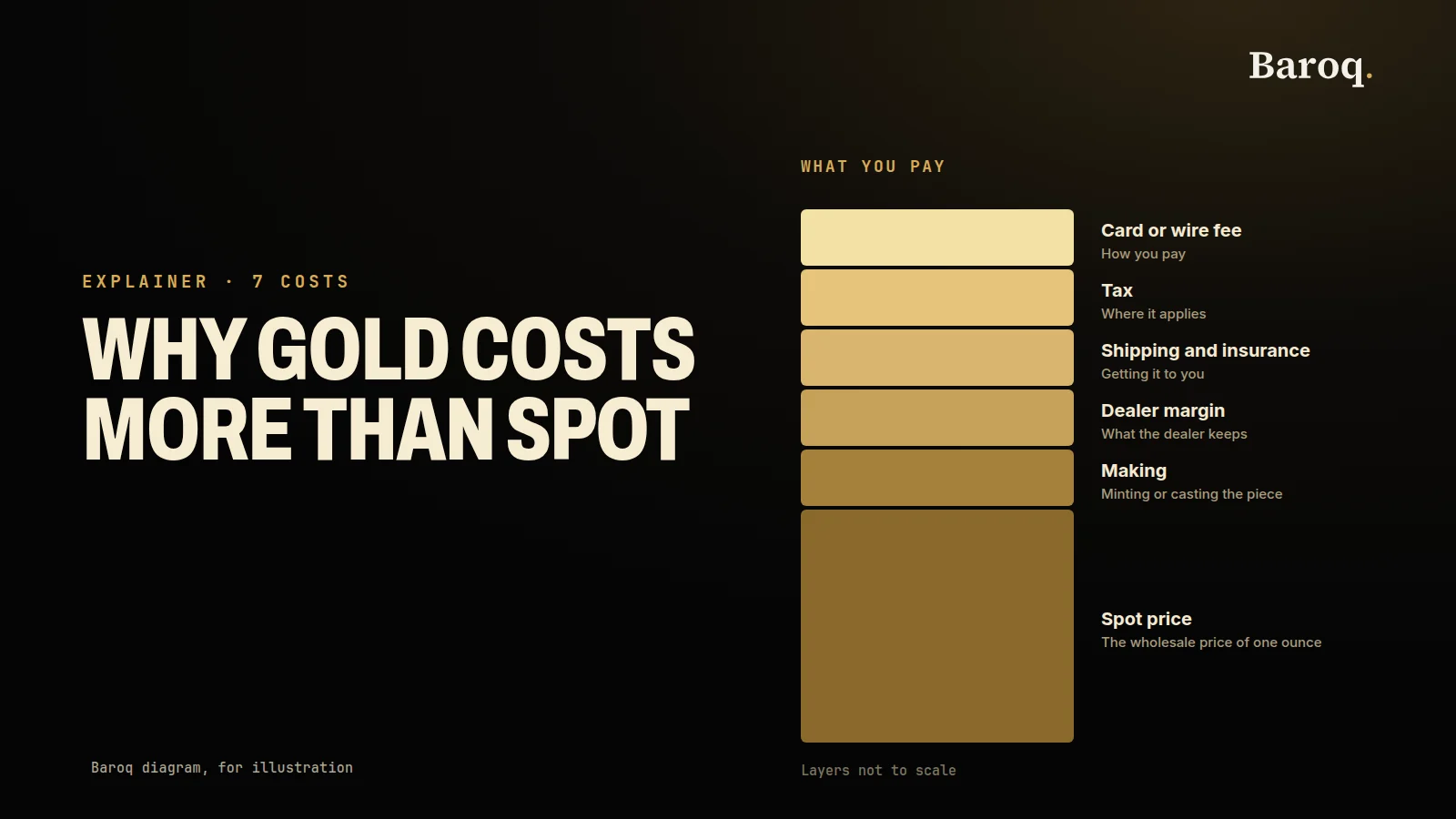
The premium is a stack, not a single fee. Each layer below is a real cost. None of the official pages opened on 10 November 2026 printed a current percentage for any layer, so each layer is described by what it pays for, not by a made-up share of the price.
Fabrication
Someone cuts, melts, casts or stamps a wholesale bar into the weight you asked for. The LBMA guide is direct: from the loco London price, dealers offer other sizes and forms at premiums or discounts to cover the cost of producing small exact-weight bars, or bars of a fineness different from the 995 minimum. A one-gram bar and a one-ounce bar do not share that cost per gram. The fixed work of weighing, assaying, stamping and packing is spread over less gold as the piece gets smaller. That is the mechanical reason the gold premium over spot is higher, per ounce, on a small piece.
The Council lists the sizes the retail market actually sells. Bars come in 1, 10, 20, 50, 100 and 1,000 grams, and in 1, 10, 100 and 400 troy ounces, with a purity between 99.5 and 99.99 percent, from manufacturers the industry accredits. A 400-ounce bar is the wholesale shape. A 1-gram bar is the other end of the same sentence in the LBMA guide. Between them, the premium per ounce usually falls as the bar gets larger, because you are buying more of the metal the benchmark already prices and less of the work of making a tiny exact piece. "Usually" here is the Council's "in general", not a table of today's percentages.
Minting
A coin is a bar that has also been struck as a coin. The Council says investment gold coins are typically issued by governments and have a face value. Their value is derived from their gold content. Purity is typically 91.67 percent, which the Council calls 22 carat, or 99.99 percent, 24 carat. The face value is there so the piece is a coin. It is not the price. The gold is worth far more than the face, which is why the coin is sold against the spot price plus a premium, not against the denomination.
Minting is extra work a plain bar does not have: a design, a press, a legal-tender status, often a capsule. That work is a reason a well-known coin can cost more per fine ounce than a bar of the same fine weight from a recognised refiner. It is also a reason the coin can be easier to sell later, because another dealer recognises it. Easier is not the same as free. The buy-back section below is where that recognition either shows up in the price or does not.
A collector coin is a further step. The Council's glossary separates numismatic coins from bullion coins. A collector coin is expected to have a value beyond the metal, from scarcity or design, and premiums are higher and liquidity is typically lower. If the price you are quoted cannot be explained by the fine gold plus a fabrication premium, ask whether you are buying the gold or the rarity. Those are different purchases. The EU and UK tax rules, below, also draw a line at coins normally sold far above the value of the gold inside them.
Distribution, shipping and insurance
The benchmark is loco London. You are probably not in that vault. The guide says the shipped price can include freight and insurance, and that a consuming country can already stand at a premium to London before the coin is small. Those are distribution costs. They are real, they move, and they are a reason two dealers in two countries can quote two premiums on the same product on the same afternoon while the auction price is the same.
The Council separates the costs you still carry after you have paid the premium: delivery, storage and insurance. A quote that says "plus shipping" has not finished. Add the postage, the insured value and any fee for the vault before you compare the package with spot. A quote that says the price is delivered and insured has those dollars already inside the premium. Either way you can measure it. You cannot measure it if you ignore it.
Storage after the parcel arrives is a holding cost, not part of today's premium, but it changes the round trip if you ever need the metal moved again. An allocated holding, in the LBMA guide's terms, is specific bars and a storage fee that varies by operator. An unallocated holding is a claim on a pool, cheaper and simpler in that guide's description, and it is also credit exposure to the firm that holds the account. A retail product you take home is a third thing: you hold the metal, and you hold the risk of theft, fire and a home policy that may not cover bullion. The purchase premium does not pay for that last risk.
The dealer's margin
The person who sells you the coin is not obliged to sell it at the auction price. The LBMA guide's definitions, in the 2017 edition, include a mark-up: the spread or charge that may be included in the final price to compensate the firm for risks taken, costs incurred and services rendered to a particular client. That is the dealer's margin. It pays for the stock sitting on the shelf, the staff, the website, the hedging of that stock against a moving spot price, and the fact that the firm will, if it is a real dealer, also make you a bid when you come back.
A margin is not a scandal by itself. A hidden margin is a bad quote. The Council's principle is the right test: you should be given enough information to calculate the premium over the base price. A dealer that will show you the spot it is using, the product price, and the buy-back, has given you that. A dealer that shows one all-in number and will not say what "spot" it means has not.
The way you pay
A bank transfer, a card and a financed payment do not cost the dealer the same amount to accept. If the quote changes when you change the way you pay, the difference is a payment-method fee, and it belongs inside the premium you are measuring. None of the official pages opened for this article printed a typical card fee or a typical wire fee. This page will not invent one. Ask for both numbers. Use the number that matches the way you will actually pay, not the lower number that applies only to a method you will not use.
The same rule covers "storage included for a year" or "free shipping over a certain order". Fold every dollar you will really pay into one pile, then divide by the fine ounces. That pile, minus the benchmark, is the gold premium over spot. A headline that leaves out the card fee is a smaller number than the one that leaves your account.
Why do gold bars and coins have different premiums?
Gold bars and coins have different premiums because the spot price already describes a large wholesale bar, while a coin adds minting and a smaller piece spreads the same making costs over less gold.
Put the official descriptions side by side and the pattern is the weight, the work and the recognition.
A London Good Delivery bar, 350 to 430 troy ounces at a minimum of 995 fineness, is the shape the published loco London price already means. You are not paying someone to turn it into something else. Institutions use it because it is the clearing unit. A private buyer often cannot, and should not, take one home: the guide's usual minimum OTC ticket is 2,000 ounces, which is several of those bars. The premium over the benchmark, for a bar that is the benchmark, is a dealing spread and a location difference, not a fabrication story.
A 100-ounce bar, a kilo, a ten-ounce bar and a one-ounce bar are successive cuts of that idea. Each cut adds work and adds a piece that is easier to handle and easier to sell in a smaller amount. The Council's certificate products make the same point from the other direction: ownership is often provided in pooled allocated large bars, which are available at a lower premium than individual bars. Pooling is a way of letting a smaller buyer share the cheap shape. It is also, if the account is unallocated, a credit claim rather than a numbered bar. Read the account type before you treat a low premium as the same thing as a coin in a safe.
A one-ounce coin adds the mint. You pay for a government-issued piece with a face value, a design and a purity the Council puts at either 91.67 or 99.99 percent. The fine gold in a 91.67 percent coin is not one troy ounce. It is 91.67 percent of the gold weight the mint specifies. Compare that coin with spot on the fine ounces, not on the gross weight, or you will invent a discount that is only arithmetic. A 99.99 percent one-ounce coin is almost one fine ounce, and the small difference still belongs in the division. The recognised one-ounce bullion coins, and how to check one, are in Best gold coins to buy.
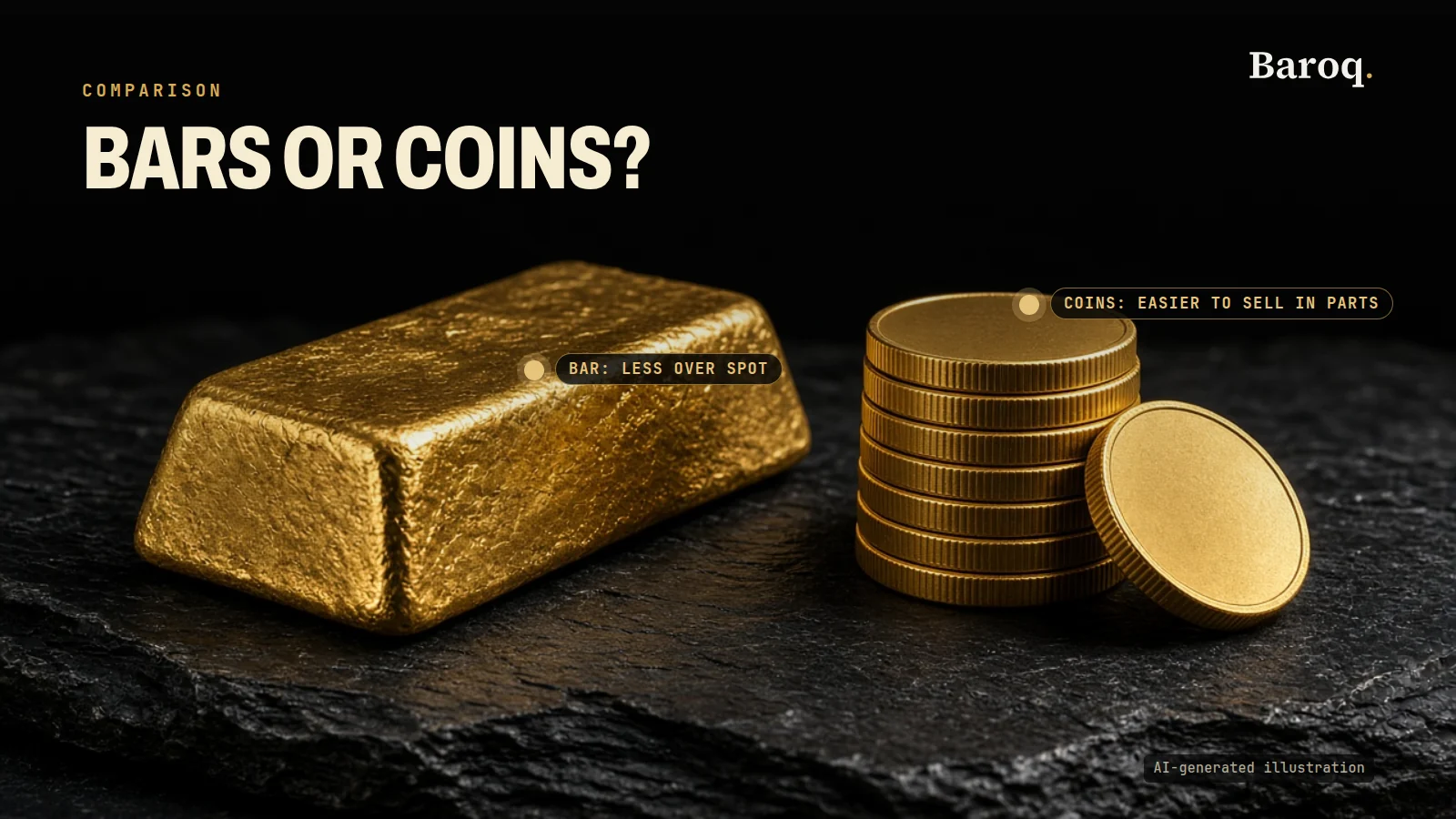
A one-gram bar is the LBMA guide's own example of a piece that is considerably more expensive, like for like, than a one-ounce bar. The gold inside is the same metal. The work per gram is not. If your aim is the most fine gold per dollar, the large recognised bar wins that narrow contest, and you then have to store it and to accept that selling a slice of it is harder than selling one coin. If your aim is a piece you can sell without selling the whole holding, the higher premium on the small coin is the price of that option. Gold bars vs gold coins sets the two forms next to each other. How to buy physical gold walks through the first purchase. This page stays with the gap between the chart and the quote.
Silver makes the same mechanism louder, because the metal price per ounce is lower and the cost of minting a coin does not fall in proportion. That comparison is in Gold vs silver. It is a reason to measure a silver premium separately, not a reason to guess a gold percentage from it.
Why premiums widen in a demand spike
The chart can move because the wholesale ounce moved. The premium can move because the finished piece became scarce. Those are independent.
On 28 May 2020 the World Gold Council published a note on the supply chain during the pandemic disruptions. It said the availability and liquidity of London Good Delivery bars in the wholesale market were relatively unaffected. It also said supply and logistical problems caused some dealer inventories of small bars and coins to run down, and left many investors facing long wait times and high premiums. The note does not print the premiums in percent. The fact it does print is the split: the large-bar market and the small-product market did not tighten together. Anyone watching only the chart in that period would have missed the number that a coin buyer was actually paying.
The mechanism is ordinary once you have the two markets in view. The auction and the futures market can still clear a large bar, or a claim on unallocated metal, while the mint is behind, the flights are reduced, or the dealer's tray of one-ounce coins is empty. The dealer who still has coins is not obliged to sell them at yesterday's premium. The dealer who has to wait for the next delivery is quoting a product he cannot replace quickly. The premium widens. When the trays refill, the same guide that described premiums also describes discounts, for example when demand for kilobars is insufficient. The premium can narrow again without the auction price doing anything you would call dramatic.
A spike in the spot price itself can push the same door. If buyers rush for coins because the chart jumped, they are demanding the scarce shape, not the 400-ounce bar. The chart and the premium can rise together. They can also part company: the chart can fall while the premium stays wide, if the coins are still on back order, and the chart can rise while the premium shrinks, if dealers are heavy with stock. Measuring only one of them is how a buyer announces that gold "got cheaper" in a week when the coin did not.
What to do with that, practically, is dull. If you are buying a small coin in a week when every dealer you ask has a wait, the premium is telling you the product is scarce. You can pay it, you can buy a larger bar if the premium on that bar is calmer, or you can wait. You cannot remove the scarcity by refreshing the chart.
The buy-back price and the round trip
The premium over spot is the cost of getting in, measured against the benchmark. The round trip is the cost of getting in and out on the same day, measured against the dealer.
Ask for both prices before you pay. The selling price is what you pay the dealer for the piece. The buy-back price is what the dealer will pay you for that same piece, in the same condition, on the same day. Subtract. The difference is money you lose if you change your mind before the spot price has moved. It is the bid-ask spread of the retail product. It includes the dealer's margin on the way in and on the way out, and it includes any gap between the wholesale bid and the wholesale offer that the dealer is passing on.
A narrow premium over the offer does not imply a narrow round trip. A dealer can sell a famous coin close to the wholesale offer and still bid far below the wholesale bid, or can refuse to bid at all until the coin is in hand. A wide premium over the offer is not automatically a wide round trip either: a coin that is recognised everywhere can be expensive to buy and still easy to sell, so the buy-back sits closer to the wholesale bid than the selling price sits to the offer. You only know which case you are in if you have both numbers.
Condition belongs in the bid. A coin out of its capsule, a bar with a scratched assay stamp, a piece the dealer does not recognise, will not be bid as the same product. Collector pieces, in the Council's glossary, already carry higher premiums and typically lower liquidity. Their round trip can be wide because the next buyer is a collector, not a refiner.
Do the round trip in fine ounces if you want to compare products, and in cash if you want to know what leaves your account. Cash is the one that pays the invoice. Write it down. A dealer that will not quote a buy-back is asking you to buy a product whose exit price is a surprise. Silver Gold BullPartner is the only dealer this guide links to. That link is an affiliate link. We may earn a commission if you use it. It does not add to the price you pay, and it does not change the checks above.
Is investment gold free of VAT and sales tax?
It depends on where you buy, and on whether the piece qualifies as investment gold under that authority's own page: HMRC Notice 701/21 exempts investment gold that meets its tests, subject to an option to tax; the EU VAT Directive requires Member States to exempt investment gold as Article 344 defines it; the CRA's July 2026 memorandum generally exempts a precious metal at its stated purity and form, and treats gold below 99.5 percent as generally taxable; the ATO ruling GSTR 2003/10 input-taxes supplies of precious metal in investment form, apart from a first supply after refining and exports; and the IRS publications opened here list gold, silver and other metals as capital assets, and cap collectibles gain at 28 percent.
The pages below were opened on 10 November 2026. They describe the categories. They are not a ruling on your invoice. Read the current page, or ask the tax authority, before a large purchase.
United Kingdom
HMRC's VAT Notice 701/21, "Gold imports and exports", was published on 30 January 2013 and the page records a last update of 31 December 2020, with a change note that it was updated because the Brexit transition period ended. It says investment gold is exempt from VAT, subject to an option to tax.
Investment gold, in that notice, is one of three things. First, gold of a purity not less than 995 thousandths, in a bar or a wafer, of a weight accepted by the bullion markets. Second, a gold coin minted after 1800, of a purity not less than 900 thousandths, that is or has been legal tender in its country of origin, and of a description normally sold at a price that does not exceed 180 percent of the open market value of the gold in the coin. Third, a coin on the list in VAT Notice 701/21A. Supplies of investment gold are exempt. So is a supply that confers the right to possession of it, which the notice says includes unallocated investment gold, loans, swaps, forwards and futures. Options are not in that list. Supplies of investment gold to a person who is not a taxable person are always exempt. A producer, or a business that normally supplies gold for industrial use, may opt to tax some supplies to another taxable person, so that it can recover input tax. That option is a business election. It is not a private buyer's choice at the checkout.
The notice also tells a business when it must write to HMRC: the first exempt supply of investment gold over £5,000, or exempt supplies to any one customer over £10,000 in a twelve-month period, within 28 days. That is a trader's duty. A private buyer still keeps the invoice, because the invoice is what shows the exemption was applied and what the gold cost.
A coin normally sold above 180 percent of the gold in it is outside the definition. That is the tax system's way of saying a collector's premium is not investment gold. If the quote is far above the gold value, do not assume the VAT exemption applies. Ask, and read Notice 701/21A for the coin list.
European Union
Council Directive 2006/112/EC, the EU VAT Directive, has a special scheme for investment gold. Article 344 says investment gold means, first, gold in the form of a bar or a wafer of weights accepted by the bullion markets, of a purity equal to or greater than 995 thousandths, whether or not represented by securities. Second, gold coins of a purity equal to or greater than 900 thousandths, minted after 1800, which are or have been legal tender in the country of origin, and which are normally sold at a price which does not exceed the open market value of the gold in the coins by more than 80 percent. Those coins are not regarded as sold for numismatic interest. Member States may exclude from the scheme small bars or wafers of a weight of 1 gram or less.
Article 346 says Member States shall exempt from VAT the supply, the intra-Community acquisition and the importation of investment gold, including investment gold represented by certificates for allocated or unallocated gold or traded on gold accounts, and including gold loans and swaps involving a right of ownership or claim, and futures and forward contracts that lead to a transfer of that right or claim. The 80 percent test in the Directive and the 180 percent test in the UK notice are the same line: a price at the open-market value of the gold, plus 80 percent of that value, is 180 percent of the gold value. A coin priced above that line is not in the scheme.
The Directive is the common frame. A Member State still writes the local procedure, publishes the yearly coin list through the Commission, and can take the option to exclude bars of 1 gram or less. A buyer in one EU country should not assume a 1-gram bar is treated identically next door. The exemption is for investment gold as defined, not for every object that looks yellow.
Canada
The Canada Revenue Agency's GST/HST Memorandum 17-1, the July 2026 version, which replaced the April 1999 version, defines a precious metal for GST/HST purposes. It is a bar, ingot, coin or wafer of gold, silver or platinum, refined to at least 99.5 percent for gold and platinum, and at least 99.9 percent for silver. A bar, ingot or wafer at that purity must generally be recognised for trading on Canadian financial markets, and it ordinarily carries a purity mark and the mark of the refiner or issuer. For coins, only metal at the required purity that a government authority has issued, and that may be used as currency, qualifies.
A supply of that precious metal is a supply of a financial service and is generally exempt. The first sale of newly refined precious metal, by the refiner or by the person for whom it was refined, is zero-rated under the memorandum. Later supplies are exempt. Gold below 99.5 percent, or gold that is not a bar, ingot, coin or wafer, is generally taxable. A 22-carat coin, which the World Gold Council describes at 91.67 percent, sits below the 99.5 percent line in this definition. A buyer who assumes "investment gold is tax-free, as in Europe" can be charged GST/HST on a coin that would have been exempt in the UK. Ask whether the piece meets the memorandum, and whether the tax is inside the quote. The memorandum says it may not reflect legislation passed after it was issued. The July 2026 text is the one opened for this page.
Australia
The Australian Taxation Office ruling GSTR 2003/10, "What is precious metal for the purposes of GST?", says the first supply of precious metal after its refining may be GST-free. Apart from that case, and apart from exports, supplies of precious metal are input taxed. Precious metal includes gold, in an investment form, of at least 99.5 percent fineness. Jewellery made of gold is not precious metal: it has the character of jewellery, not of the metal. To be in an investment form, the ruling says the gold must be a bar, wafer or coin that can be traded on the international bullion market, must bear a mark or characteristic accepted as identifying its fineness and quality, and must usually be traded at a price set by reference to the spot price of the metal in it.
Input taxed, for a buyer, means GST is not added on top of that supply in the way it is added to ordinary goods. It is not the same sentence as the UK exemption, and the first-supply GST-free case is a refiner's rule, not a shopper's slogan. A coin or bar that fails the fineness, the mark or the "priced from spot" test is not in the definition, and a buyer should not assume the treatment. The ruling says the PDF is the authorised version. The HTML text opened on 10 November 2026 is what this summary follows.
United States
The pages the Internal Revenue Service publishes, opened the same day, describe the tax when you sell the metal, not a national sales tax when you buy it. Publication 544 (2025) lists gold, silver and other metals among capital assets, and says gold, silver, gems, stamps and coins are capital assets except when a dealer holds them for sale. A dealer treats the sale as ordinary business income. Publication 550 (2025) says the same, and it says a collectibles gain includes gain on metal such as gold, silver and platinum bullion, and on coins, held more than one year. Topic 409 says net capital gain on collectibles such as coins or art is taxed at a maximum 28 percent rate. Publication 550 adds the cap in the other direction: if your ordinary rate is lower than 28 percent, that lower rate is the one that applies. The 28 percent figure is a ceiling, not a flat tax on every ounce.
This page does not list state sales taxes. They are set by states, they differ, and no single federal page opened here tabulates them. Before you buy, read the tax agency page for the state where the sale is treated as taking place, and ask the dealer whether that tax is in the number on the screen. When you sell, the federal question is a capital gain or loss against your basis, which is generally what you paid, and the holding period, which Topic 409 measures from the day after you acquired the asset through the day you disposed of it. Keep the invoice. Without it you are guessing the basis.
How to compare a quote with the spot price
You can do this on a sheet of paper. The official pages support the steps. They do not support a universal percentage, so the steps use your quote, not a sample premium.
- Write the product exactly as the dealer names it: weight, purity, mint or refiner, and whether it is a coin, a bar, or a claim on a pool.
- Convert to fine troy ounces. Gross weight times purity. Use 31.1035 grams to the troy ounce if the listing is in grams, which is the LBMA guide's figure. A 91.67 percent coin is not one fine ounce.
- Name the benchmark and read it at the same time as the quote. Say whether it is the latest LBMA Gold Price, a futures price, or the dealer's own "spot", and whether you are looking at the bid, the offer or a mid. For a purchase, start from the offer.
- Ask whether the quote includes delivery, insurance and the payment method you will use. If it does not, add those dollars.
- Ask whether VAT, GST, HST or a state sales tax is inside the figure or will be added. Use the rules in the region section, then the current official page.
- Divide the all-in cash by the fine troy ounces. Subtract the benchmark offer. That difference is the gold premium over spot, in dollars per fine ounce. Divide it by the benchmark if you want it as a share. The share is yours, from your quote. It is not a figure this page is willing to invent.
- Ask the buy-back on the same piece, same day, same condition. Selling price minus buy-back is the round trip. Keep it next to the premium. They will not match, and they do not have to.
Do it twice, at two dealers, on the same day. The lower premium is not automatically the better purchase if the buy-back is worse, if the tax treatment differs, or if one quote is for metal you will own as a numbered bar and the other is a credit balance. The LBMA guide's distinction between allocated and unallocated is the question to ask of any "low premium" account product.
A live screen to start from is Baroq Markets. It is a screen, not a substitute for the dealer's written quote, and it does not know the premium on the piece you are about to be offered.
Where these pages were opened
Each source below was opened on 10 November 2026. If the publisher revises a page, the publisher's page wins.
- LBMA, LBMA Gold Price. IBA administers the auction; the LBMA owns the intellectual property; fifteen direct participants; IOSCO alignment, as that page states it.
- ICE Benchmark Administration, LBMA Gold and Silver Price. Unallocated loco London gold; auctions at 10:30 and 15:00 London time; US dollar price formation; 30-second rounds; settlement two good UK business days later.
- LBMA, The Price, in the guide to the loco London market. Troy ounce 31.1035 grams; fine troy ounce; Good Delivery gold 350 to 430 ounces at a minimum of 995; loco London; spot date; location premiums and discounts; freight and insurance; small bars more expensive like for like.
- LBMA, Precious Metal Accounts. Unallocated clearing, described as probably in excess of 90 percent of wholesale OTC trades; the holder as a creditor; allocated bars by weight list.
- LBMA, The Guide, 2017 edition. Standard spot dealing amount 5,000 fine ounces; usual minimum 2,000 troy ounces; the "say" two-way example of $1,265 to $1,265.50; the definition of mark-up.
- CME Group, Gold product overview. GC is 100 troy ounces with a $10 minimum tick; MGC is 10 troy ounces with a $1 minimum tick.
- World Gold Council, How to invest in gold. Premium over spot on bars and coins; delivery, storage and insurance left with the buyer; bar sizes and purities; coin purities of 91.67 and 99.99 percent; large bars at a lower premium than individual bars in certificate products.
- World Gold Council, Retail Gold Investment Principles, copyright 2020. Glossary definition of spot and of premiums; the request that providers let a customer calculate the premium over the base price; collector coins and liquidity.
- World Gold Council, Gold market supply chain shows resilience amid disruption, 28 May 2020. Large bars relatively available; small bars and coins, long waits and high premiums.
- HMRC, VAT Notice 701/21, published 30 January 2013, last updated 31 December 2020. Investment gold exempt; 995 thousandths; coins at 900 thousandths and 180 percent of gold value.
- European Union, Council Directive 2006/112/EC, Articles 344 and 346. The special scheme, the 80 percent coin test, the 1-gram option, the exemption.
- Canada Revenue Agency, GST/HST Memorandum 17-1, July 2026 version. Precious metal at 99.5 percent for gold; exempt supply; first refined sale zero-rated.
- Australian Taxation Office, GSTR 2003/10. Precious metal, investment form, input taxed supplies, first supply after refining.
- Internal Revenue Service, Topic 409, Publication 544 (2025) and Publication 550 (2025). Gold and silver as capital assets; collectibles maximum 28 percent; the lower ordinary rate when it is lower.
A quote and a dealer are not Baroq's product. The desk, the research tools and the calculators are. For those, See plans.
Join the free Telegram channel: https://t.me/baroqtech
Educational content, not financial advice. Prices, fees and offers change: check them on the provider's own site before you sign up. Trading leveraged products carries a high risk of losing money, and you can lose all of it.