Disclosure Partner links are marked. We may earn a commission if you use one. It costs you nothing extra and never changes our verdict. How we review
Physical gold vs gold ETF is a choice about what you hold, not a forecast of the gold price. Bars and coins, taken together, are the metal. A gold ETF is a security that follows that price and trades on an exchange. This page compares premiums, storage, insurance, ongoing fees, liquidity and the buy-back, so you can see which wrapper fits. It does not replay the choice between a bar and a coin. That sits in Gold bars vs gold coins.
Bars carry the lowest premium per ounce, coins are easiest to resell in small amounts, and ETFs are cheapest to hold, but you own a fund share, not metal.
Cheapest to hold is the right description when the alternative is a vault fee you would otherwise pay. A safe you already own, and a policy that already covers bullion, can cost less per year than a fund fee. The gold coin premium over spot, and the case for a larger bar, are worked through in that bars and coins comparison. From here, both formats are simply physical gold.
Side by side
| Physical gold | Gold ETFs | |
|---|---|---|
| Premium over spot | You pay a dealer premium over the live gold price. Larger bars are usually lower per ounce than coins | No dealer premium. The share price can sit above or below the gold value per share |
| Storage | You arrange a safe, a bank box or an allocated vault | You store nothing. A custodian holds the bars for the product |
| Insurance | Yours to buy. A home policy may leave bullion out. A vault contract usually includes cover | The custodian's arrangements cover the bars. Your broker's scheme covers the share as a security, up to its limits |
| Ongoing fees | Vault or box rent if you pay for storage. A safe you already own can mean no yearly bill | A yearly expense ratio taken from the product, plus brokerage commission when you trade |
| Liquidity | Sell to a dealer, a shop or the vault. Insured shipping can take days | Sell the share on the exchange during market hours, in the size the market will take |
| Buy-back spread | The gap between the dealer's price today and the price they pay you back the same day | The bid-ask spread, plus any gap between the share price and net asset value |
| Minimum buy | One small bar or coin. Small pieces carry a higher premium per ounce | Often one share, once a brokerage account is open. The broker sets any minimum |
| Who actually holds the metal | You, when it is allocated and in your safe or your vault. Unallocated is a claim on the dealer | The product's custodian. You hold a share in a trust, or a note of the issuer |
- Physical goldPeople who want allocated metal in their own name and can store and insure it.
- Gold ETFsPeople who want to buy and sell on an exchange and accept a yearly fund fee and a custodian.
Physical gold vs a Gold ETF
The live gold price is the same starting point for both. You can follow it on Baroq Markets. What you own after you pay is different, and that difference is the whole of gold etf vs physical gold.
With physical gold you own metal, when the purchase is allocated. A bar or a coin is identified as yours: in your safe, in a bank box, or in a vault account that stores specific bars in your name. Weight and purity are stamped on the piece or written on the assay card that comes with a bar. Selling it is a sale of metal.
An unallocated account is another contract. You have a claim on gold, not a list of bars with your name on them. The dealer owes you metal. If the dealer fails, you are one of the people it owes. How to buy physical gold walks through that difference, and through the dealer checks that sit around a first purchase.
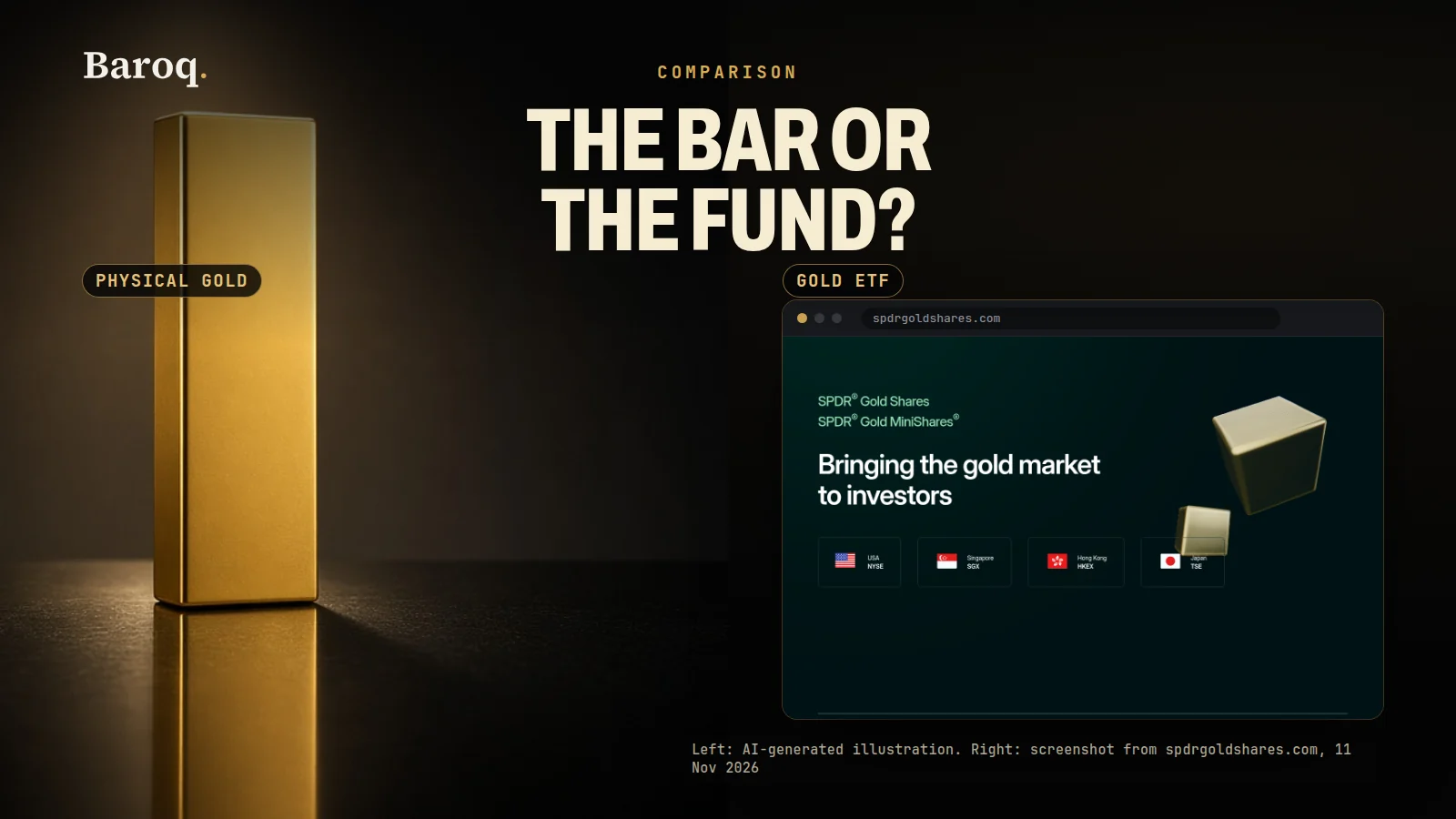
A gold ETF is a security with gold behind it, in one legal form or another. The label on the fund page is not enough. Two large products, read on the issuers' own pages on 10 November 2026, show two different forms:
- SPDR Gold Shares (ticker GLD), a US trust. The sponsor's fact sheet says the objective is for the shares to reflect the price of gold bullion, less the trust's expenses. It says the shares are fractional, undivided interests in the trust, and that the trust's assets are physical gold bullion and, from time to time, cash. The shares trade on NYSE Arca.
- iShares Physical Gold ETC (ticker SGLN), listed in London. The iShares page describes it as a series of secured debt securities issued by iShares Physical Metals plc, linked to physical gold. It says those securities are debt, and that they are not units in a collective investment scheme.
Both are built around gold. One is an interest in a trust that holds bars. The other is a note of a company, secured on metal. A futures product is a third thing: contracts that expire, not a vault of bars. The holdings section of the prospectus is the page that tells you which of the three you are about to buy. Searches that say "gold ETF" often mix all three. Read the holdings before the ticker.
Leave bar versus coin on its own page
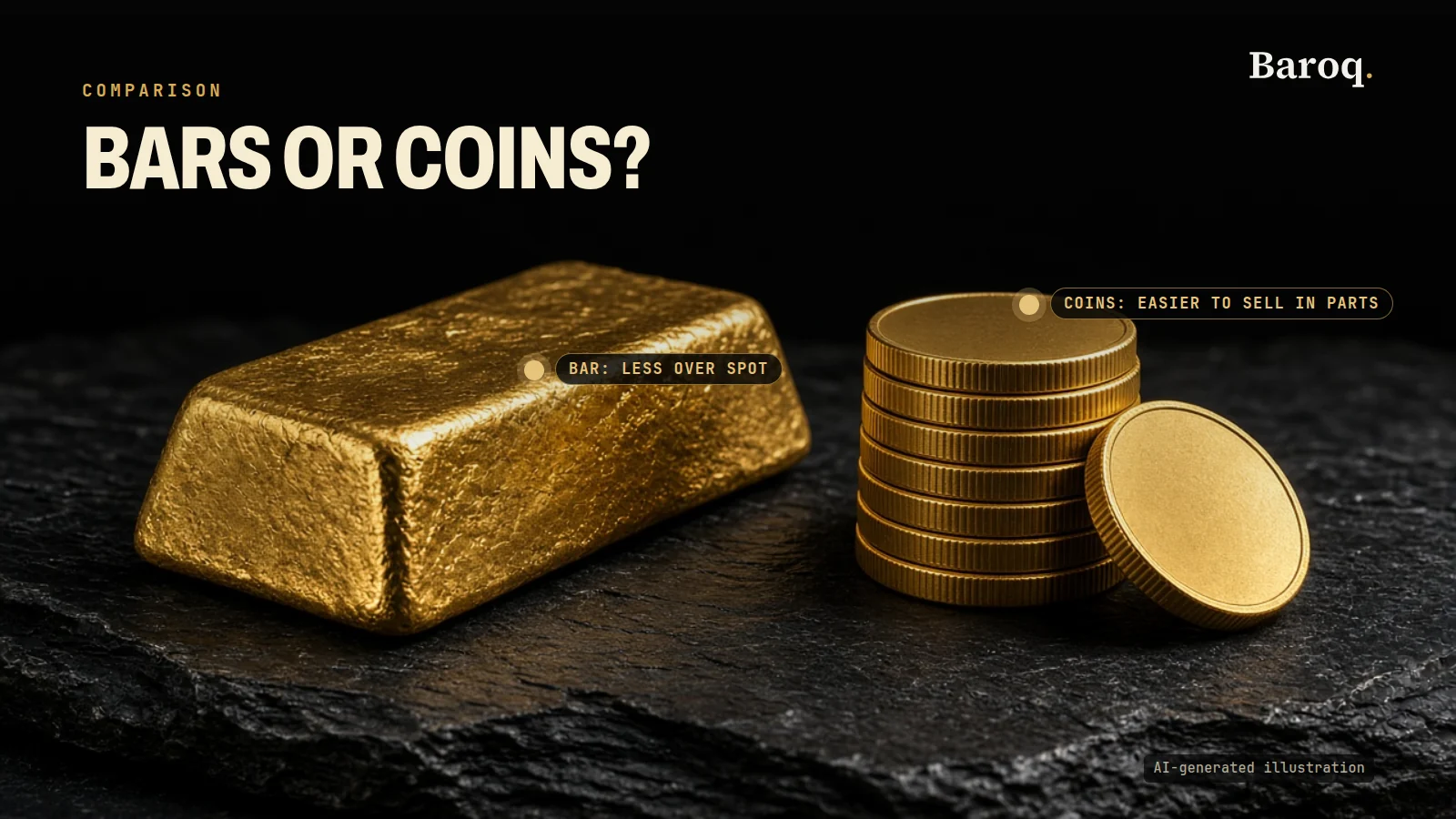
Inside physical gold, a bar and a coin still differ. A larger bar usually carries a lower premium per ounce. A well-known coin is easier to sell one piece at a time. Those are real differences, and they already have a full comparison, with its own table, in Gold bars vs gold coins. Use that page after you have decided you want metal. Using it to choose between metal and a fund mixes two decisions and answers a question this page is not here to settle.
If the open question is gold or silver, rather than the wrapper, the pillar comparison is Gold vs silver. Silver is bulkier, it is usually taxed differently in Europe, and it swings harder. This page assumes you already want gold exposure and you are choosing how to hold it.
Premium over spot on the day you buy
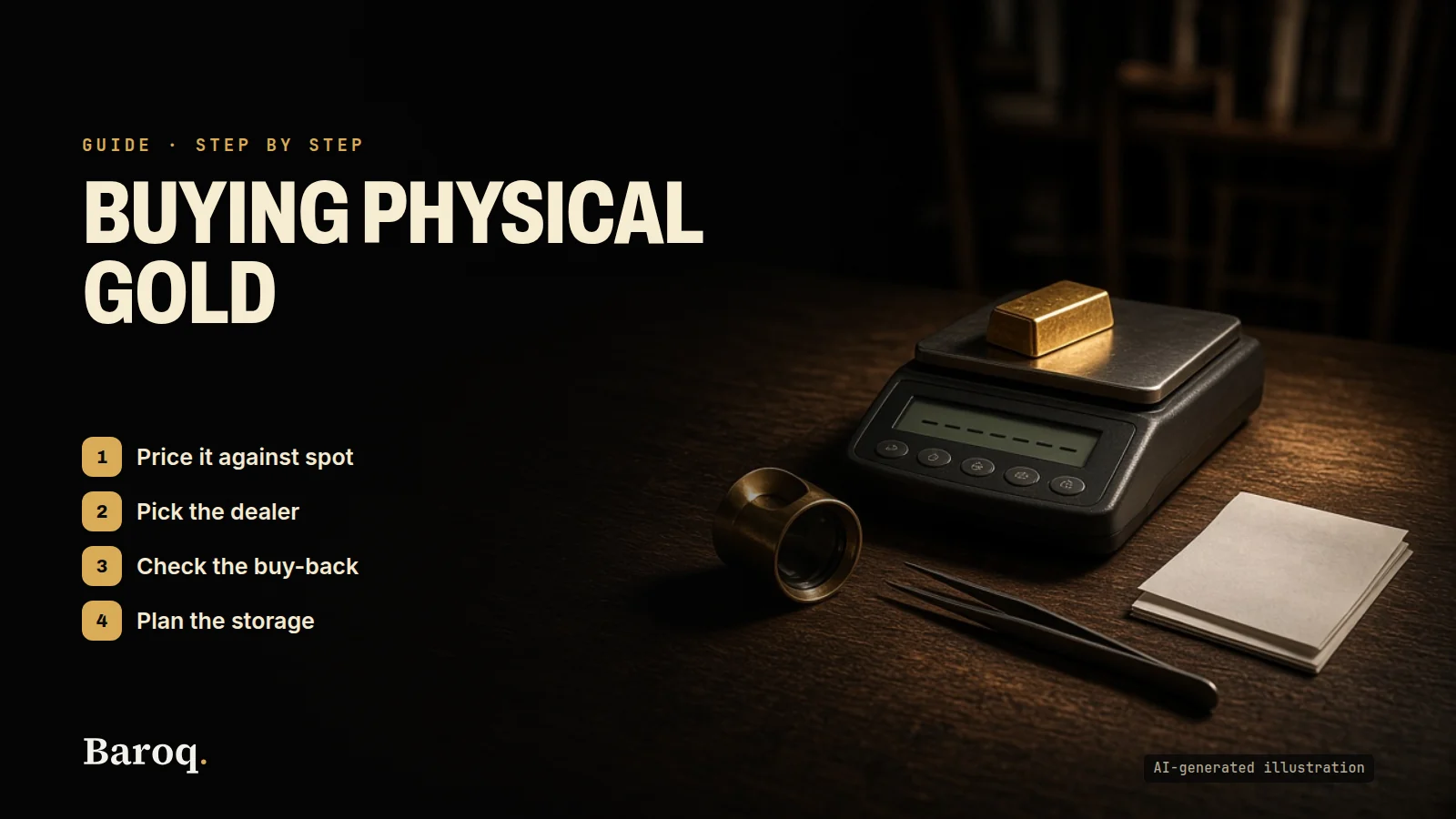
Physical gold is priced from the spot price plus a premium. The premium pays for refining, minting, shipping, insurance and the dealer's margin. The same amount of work goes into a small piece as into part of a large bar, so the premium per ounce is higher on the small piece. In a rush to buy, premiums widen even when spot has barely moved. The number to put beside the premium is the buy-back price: what that dealer would pay you for the same piece on the same day. The gap between the two is the cost of a round trip. How to buy physical gold sets out how to read a dealer page and what to ask before you pay.
Coins sit at the high end of that premium more often than large bars do. That gold coin premium over spot is the price of a minted piece that dealers know on sight. It is not a reason, by itself, to prefer a fund, and it is not a full tour of which coin to buy. The bars and coins page is the place for that tour. On this page the point is simpler: whatever bar or coin you pick, you pay spot plus a dealer premium, and you should see both the offer and the buy-back before you order.
A gold ETF is priced as a share. Buyers and sellers set that price during the session. The sponsor of SPDR Gold Shares says the share can trade above or below the trust's net asset value, the gold per share after the trust's costs. You also pay whatever commission and spread the brokerage account charges. This blog does not review brokers. The account is the pipe the share travels through.
There is no single gold price, and no single share price, worth freezing in this article. Both move every day. Check spot on Baroq Markets, then the dealer's premium or the fund's latest value on the issuer's site, on the day you buy.
Ongoing fees for every year you hold
The two costs arrive at different times. That is why a one-day comparison of the sticker price misleads people.
Physical gold asks for most of its extra cost up front, in the premium, and then again if you pay someone to store and insure it. A home safe has a purchase cost and takes space. A bank box has a yearly rent, and the bank often does not insure what is inside. An allocated vault charges a fee, usually yearly, and the metal is insured under that contract. If you already have a safe and a policy that covers bullion, the yearly cash cost can be close to nothing. If you do not, get the quote before you choose a large bar. A kilo of gold is a small object and a large loss.
A gold ETF asks for a yearly expense ratio, taken out of the product. You do not get a separate bill. The gold per share shrinks by about that ratio over a year, which is why the SPDR objective is the gold price less the trust's expenses. Brokerage commission sits on top when you buy and when you sell. The SPDR fact sheet says trading often can add enough commission to use up the advantage of a low fee. A share you buy and leave alone does not keep paying commission. A share you trade in and out does.
Two ratios, each read on the issuer's site on 10 November 2026, show why one number is not the cost of every gold ETF:
- SPDR Gold Shares (GLD). The fund page showed a gross expense ratio of 0.40% a year. The page describes that figure as the trust's total annual operating expense ratio, gross of any fee waiver, as set out in the prospectus.
- iShares Physical Gold ETC (SGLN). The product page showed a total expense ratio of 0.12% a year. iShares describes that figure as the cost of managing and operating the product, mainly the management fee plus trustee, custody and operating costs.
Other gold products publish other ratios. Some change when a new prospectus is filed. Read the current document for the ticker you are actually buying, and write the date next to the figure. A ratio from last year is a stale fact.
Which one costs less is a holding-period sum. A wide premium on a small coin can cost more on day one than several years of a 0.40% ratio. A long hold of a fund at 0.40% takes a larger slice than a bar in a safe you already own and already insure. Add the buy-back spread on the metal, and the commission on the share, before you decide the round trip is cheap. The line at the top of this page, that ETFs are cheapest to hold, is this yearly-fee case. It flips when your storage is already paid for and the premium on the piece you want is narrow.
Storage, insurance and who has the bars
Decide storage before you pick a bar size. A one-ounce coin fits almost anywhere. A London Good Delivery bar does not. The UK VAT notice on investment gold, checked on 10 November 2026, lists weights the bullion markets commonly trade, from 1 gram pieces up to the London Good Delivery bar it describes as 12.5 kilograms, plus kilo bars and the usual ounce sizes. The EU directive lets a member state leave bars or wafers of 1 gram or less outside the investment-gold scheme. The practical point is the one that changes the order: the piece has to fit the storage you actually have.
Three places come up again and again. How to buy physical gold compares them in more detail:
- At home. You can reach it any day. You also carry theft, fire, and the question of whether the home policy covers bullion, and up to what amount. Read the policy. A safe the insurer excludes is a safe full of uninsured metal.
- A bank safe deposit box. Access follows the branch hours. Ask, in writing, whether the bank insures the contents. Many contracts leave the contents to you.
- An allocated vault. Specific bars are held in your name, insured under the storage contract, for a yearly fee. Selling can be a transfer inside the vault, so the bar does not have to travel. The fee and the exit steps belong in the quote you accept.
Insurance is its own line, not a footnote on the safe. Physical gold is insured only if a policy says so. Ask the insurer about bullion by name, and about the limit. A vault's cover is only as wide as that contract. Get the exclusion list with the fee.
A gold ETF removes the home-safe question and replaces it with a custodian. On 10 November 2026 the SPDR Gold Shares page named two gold custodians, HSBC Bank plc and JPMorgan Chase Bank, N.A. The fact sheet named The Bank of New York Mellon as trustee. That is one trust. Another product names another custodian. You do not choose the vault, and you do not collect a bar in exchange for a single share.
The SPDR page says only certain investors can tender shares for redemption, and only in creation-unit aggregations. Everyone else sells the share on the exchange. If the reason you want gold is a bar you can carry out of a vault, a share does not do that job. You own the claim the prospectus describes. The custodian holds the metal.
Liquidity and the buy-back spread
Liquidity is how fast you can turn the holding back into money, and at what gap to the gold price.
Physical gold sells to a dealer, a shop, or the vault that already holds it. A widely recognised bar or coin is the straightforward case: the dealer knows the product and quotes a buy-back price. An unusual piece takes longer and may be quoted further from spot. Shipping insured metal takes days. A shop sale is same-day and local, at that shop's spread. You cannot sell a bar at 10pm on a Sunday from a phone app. The buy-back spread is the number to collect before you buy: the dealer's selling price and the dealer's buying price, same product, same day. A tight premium on the way in means little if the buy-back is far below spot.
A listed gold share sells during the exchange session, at the price a buyer will pay, without a courier. For SPDR Gold Shares that exchange is NYSE Arca, and the fact sheet says the shares can be bought and sold through the trading day. The same fact sheet says you should not treat a liquid market for the shares as a settled fact in every session. In a calm session a widely held share is easy to sell in the size most people hold. In a broken session the bid can gap, and the share can move away from the gold value per share. The sponsor says both. The buy-back on a share is not a dealer quote. It is the bid, plus any distance between the share price and net asset value. Plan for a wide hour even if you expect a narrow one.
Selling a small amount is where a coin and a large bar diverge, and it is the main reason some holders of metal keep a few coins beside a larger bar. That trade-off is the subject of Gold bars vs gold coins, not of this page. A gold ETF solves the small sale in a different way: you sell part of the shareholding, down to whatever the broker allows as a minimum order, and the gold stays in the custodian's vault the whole time.
Who actually holds the metal
"Owning gold" describes several contracts. The question to ask is who can touch the bar, and what you are left with if they stop.
Metal in your possession. You hold it. The things that can go wrong are physical: theft, loss, fire, a safe that fails. Insurance is a contract with an insurer, with exclusions. There is no fund manager and no custodian in the chain. There is also no desk to call if the bar is gone and the policy does not respond.
Metal in a vault, allocated. The vault company holds specific bars for you. You depend on its records, its insurance and its willingness to release or transfer the bar. Read who owns the metal in the contract. Allocated and pooled are different sentences. Pooled can mean your gold is part of a batch, not a bar numbered to you.
An unallocated account. The dealer owes you gold. You depend on the dealer staying able to pay. The EU VAT rules can still treat some of these accounts as investment gold for sales tax. A tax exemption does not turn a claim into a bar.
SPDR Gold Shares. You own a fractional interest in a trust. The fact sheet says the trust's assets are the bullion and, at times, cash. You depend on the trust, the trustee and the custodians doing what the prospectus says, and on the broker keeping the share credited to your account. The share is a security. It is not a bar the broker is storing under your name.
iShares Physical Gold ETC. You own a secured note. The iShares page says the securities are limited-recourse obligations, payable only out of the secured property, and that if that property is not enough, outstanding claims stay unpaid. That is the issuer's own description of who is in the chain. The metal supports the note. The note is still the issuer's promise.
A brokerage failure and a burglary are different events. The securities scheme in your country may protect the share as a security, up to that scheme's limit. It does not hand you a bar. Ask what the scheme covers before you treat the account as a vault.
Leveraged products sit outside this comparison. A contract for difference is an agreement with a broker on the gold price. Futures are exchange contracts that expire. Neither is a gold ETF, and neither is physical gold. The four-way split is in Gold CFD, ETF, futures or physical gold. Baroq sells software for people who trade, and the plans are on pricing. The software does not buy, store or sell gold of any kind.
Tax, with no recommendation
Tax is the law where you live, plus the legal form of the product. It is not a ranking this page can finish for you. What follows is the shape of the rules on the official pages on 10 November 2026, not a bill.
European Union. Council Directive 2006/112/EC, Article 344, defines investment gold as gold in bar or wafer form, of a weight the bullion markets accept, with a purity of at least 995 thousandths, whether or not securities represent it. It also includes gold coins of at least 900 thousandths, minted after 1800, that are or have been legal tender in the country of origin, and that normally sell for no more than 80% above the open-market value of the gold in the coin. Article 346 requires member states to exempt the supply, the intra-EU acquisition and the import of that investment gold from VAT, including some certificates and gold accounts. A member state may exclude bars or wafers of 1 gram or less. The text checked was the text on EUR-Lex that day.
United Kingdom. HMRC's VAT Notice 701/21 is the live notice. The page says it was last updated on 31 December 2020, and that version was the one on gov.uk on 10 November 2026. It defines investment gold as gold of at least 995 thousandths purity in bar or wafer form of an accepted weight, or a gold coin minted after 1800 of at least 900 thousandths that is or has been legal tender and normally sells for no more than 180% of the open-market value of the gold in the coin, or a coin on HMRC's list. A supply of that gold is exempt. The UK's 180% ceiling and the EU's "no more than 80% above the gold" ceiling describe the same cap.
VAT is not the tax on a later gain. A purchase can be free of VAT and the sale can still be taxed. Keep every invoice. It is the record of what you paid, and when.
A gold ETF or ETC. It is a security. Its tax follows the prospectus and your country. The iShares page says the levels and bases of taxation can change. SPDR tells buyers to read the prospectus. Some trusts are taxed, for a holder in the United States, in a way that follows the gold rather than a typical company share. This page does not restate a rate. The rate lives in the prospectus and in statute, and both move. Read the tax section of the product you buy.
United States, on the metal. The EU and UK exemption above is not a US sales-tax rule. Whether a state taxes a bullion purchase, and how a gain is taxed, is for that state's rules and for federal rules on the day you act. Check both from the state, and from the prospectus if a fund is in the purchase.
Nothing here is tax advice. A large purchase is a question for someone who can see your country and the exact product.
Choosing a way to own gold
There is no single best way to own gold. The wrapper that fits is the one you can store, sell and explain five years from now. Work down the list and stop when an answer rules one side out.
- Do you want a bar or coin in your name? If the point of the purchase is metal you can insure and, if you choose, carry, physical gold is the holding. A share will not become a small bar because you ask.
- Where will it sit? If you have no safe, no covered insurance and no wish to pay a vault, the yearly work of physical gold is real. A listed security hands that work to a custodian and charges the expense ratio instead.
- How quickly might you need the money? If you may sell on a weekday in market hours, a listed share is built for that. If you can wait for a dealer and a transfer, metal is workable. A closed exchange and a closed dealer are the same problem at the weekend.
- What does a round trip cost? Write down the premium and the buy-back for the piece, or the expense ratio, the commission and the usual gap to net asset value for the share. Use the issuer's figure and the date you read it.
- What is the tax shape where you live? Use the section above as a map only. Confirm it before you send money.
- If you picked metal, which shape? Move to Gold bars vs gold coins. Most of that decision is the premium per ounce against how easily you can sell a small piece.
- If you are still choosing the metal? Gold vs silver is the other fork. Silver's tax and its bulk are a different sum.
Holding both is a normal result. Metal you intend to keep, plus a listed security for the slice you might sell, uses each wrapper for the job it does. The sizes are yours. Write them down before you buy, and fund them with money you can leave through a long fall in the gold price. The quote to check is the gold price on Baroq Markets. It is not an instruction to hurry.
A short checklist
- Check the live gold price on Baroq Markets.
- Decide on metal, a listed security, or a split you can say in one sentence.
- If it is metal, choose storage and insurance first, then read How to buy physical gold and the bars and coins comparison.
- If it is a security, read the holdings, the expense ratio and the tax section on the issuer's site, and write down the date.
- Compare two dealers on premium and buy-back, or two tickers on structure and ratio. Keep the invoice or the contract note.
Sources checked on 10 November 2026
Fees, custodians and legal form were read on the issuers' sites that day. Tax definitions were read on the official legal pages that day. This post states no price of gold and no price of a share, because both move. The ratios below are the figures those pages showed on that date, for those two products only.
- Council Directive 2006/112/EC, Articles 344 and 346, investment gold and the VAT exemption: https://eur-lex.europa.eu/legal-content/EN/TXT/?uri=CELEX:32006L0112
- HMRC VAT Notice 701/21, Gold acquisitions, imports, investments and VAT. The page states it was last updated on 31 December 2020: https://www.gov.uk/guidance/gold-acquisitions-imports-investments-and-vat-notice-70121
- SPDR Gold Shares fund page, including the 0.40% gross expense ratio and the custodian names: https://www.ssga.com/us/en/intermediary/etfs/funds/spdr-gold-shares-gld
- SPDR Gold Shares fact sheet, on the objective, the trust's assets, the exchange, the trustee and redemption in creation units: https://www.ssga.com/library-content/products/factsheets/etfs/us/factsheet-us-en-gld.pdf
- iShares Physical Gold ETC product page, including the 0.12% total expense ratio and the secured-debt description: https://www.ishares.com/uk/individual/en/products/258441/ishares-physical-gold-etc
Educational content, not financial advice. Prices, fees and offers change: check them on the provider's own site before you sign up. Trading leveraged products carries a high risk of losing money, and you can lose all of it.