Disclosure Partner links are marked. We may earn a commission if you use one. It costs you nothing extra and never changes our verdict. How we review
This NordVPN review answers a narrow question: what NordVPNPartner itself publishes about speed, privacy and price, and whether that is enough for someone who logs in to a broker or an exchange on public Wi-Fi. The short version is a long intro price, a higher renewal, ten devices on every plan, and a no-logs claim that a 3 February 2026 post ties to a Deloitte Lithuania review finished on 12 December 2025. We read those pages on 10 November 2026. We did not run our own speed tests. A VPN does not change whether a trade makes or loses money.
What NordVPN is
NordVPN is a paid VPN: an app that encrypts the traffic between your device and one of the company's servers, so the network you are sitting on sees the VPN server rather than each site you open. Traders meet it in three ordinary places. A cafe or airport Wi-Fi network. A hotel or a rental. A laptop that also holds a broker or exchange login.
The support article "Where is NordVPN based" says the VPN is based and operates under the jurisdiction of Panama, and that Panama has no mandatory data-retention law that would force the service to store logs. The same article says the parent, Nord Security, is based in Europe, in the Netherlands. Those are two addresses, and both matter. The VPN's legal home is the one the company names for the logging question. The parent is a separate sentence.
The product on the pricing page is three plans, Basic, Complete and Prime, sold by the month or as a longer intro. Around the VPN itself the company sells threat filtering, a password manager, cloud storage, dark-web alerts and, on Prime, identity tools aimed at US customers. Meshnet, a private link between devices, is described on its own page as free. A dedicated IP is an add-on at checkout.
This page is a review of that published product. It is not a broker review. Brokers stay on Baroq's partner pages. If you want the wider list of VPNs we read the same way, it is Best VPN for traders. The rules for every score on this blog are on How we review.
How we reviewed it
We opened NordVPN's own pages on 10 November 2026 and wrote down what they said. The set was:
- The pricing page, including the plan matrix, the renewal lines and the footnotes on charging, cancellation and refunds.
- The trust center, for the server count, RAM-only servers, protocol names and the company's account of past reviews.
- The no-logs feature page, which does not match the newer post on every count.
- The 3 February 2026 post, "NordVPN passes its no-logs assessment for the sixth time".
- Support articles on where the company is based, how the kill switch works on each app, and what a dedicated IP allows.
- The Meshnet page, for the device cap and the statement that Meshnet is free.
We did not install the apps, create an account, connect to a server, or run our own speed tests. We did not time a support reply. We did not open the Deloitte PDF, because the February post says the full report is available after you log in to a Nord Account, and it does not publish excerpts. Where two NordVPN pages disagree, this NordVPN review says so instead of picking the friendlier number.
Speed is the gap that follows from that method. The pricing page calls the service fast and points the claim at outside work by Artifact Security in June 2026 and West Coast Labs in October 2025, plus the company's own checks and some media articles, including paid ones. That is NordVPN's footnote. We are not repeating a megabit figure, because we did not measure one. A cafe link, a hotel link and a home fibre line will not match a lab figure in any case.
Prices below are US dollars as that pricing page showed them. The page says sales tax may apply. It also says the intro price is for a new customer and for the first period only, and that the subscription renews at the then-current renewal price unless you cancel. Other countries see other currencies. Read the live page on the day you pay. The date on this post is the date we read it.
The scores further down follow the five fixed criteria: cost, transparency, safety, ease of use and support. A commission on the partner link does not move them. NordVPN is the only partner key in this article. Mullvad, Proton VPN and ExpressVPN are named in plain text, with no button.
- Cost3/5The long Basic intro looks cheap beside the monthly price, but $139.08 a year on renewal is the figure to set next to Mullvad's flat monthly rate and Proton VPN's renewal.
- Transparency4/5Intro price, renewal and the plan matrix are on the pricing page, while the audit PDF is behind a login and the dedicated IP price was not on that matrix.
- Safety4/5The company says the VPN is under Panama law and describes a December 2025 Deloitte review, which we could not open without an account.
- Ease of use4/5The Windows help article is a download, a login and one connect button, and we did not time a setup ourselves.
- Support3/5The pricing footnote says support is available at all hours for a refund request, and we did not send a question so we cannot time a reply.
NordVPN review: plans and the price on the page
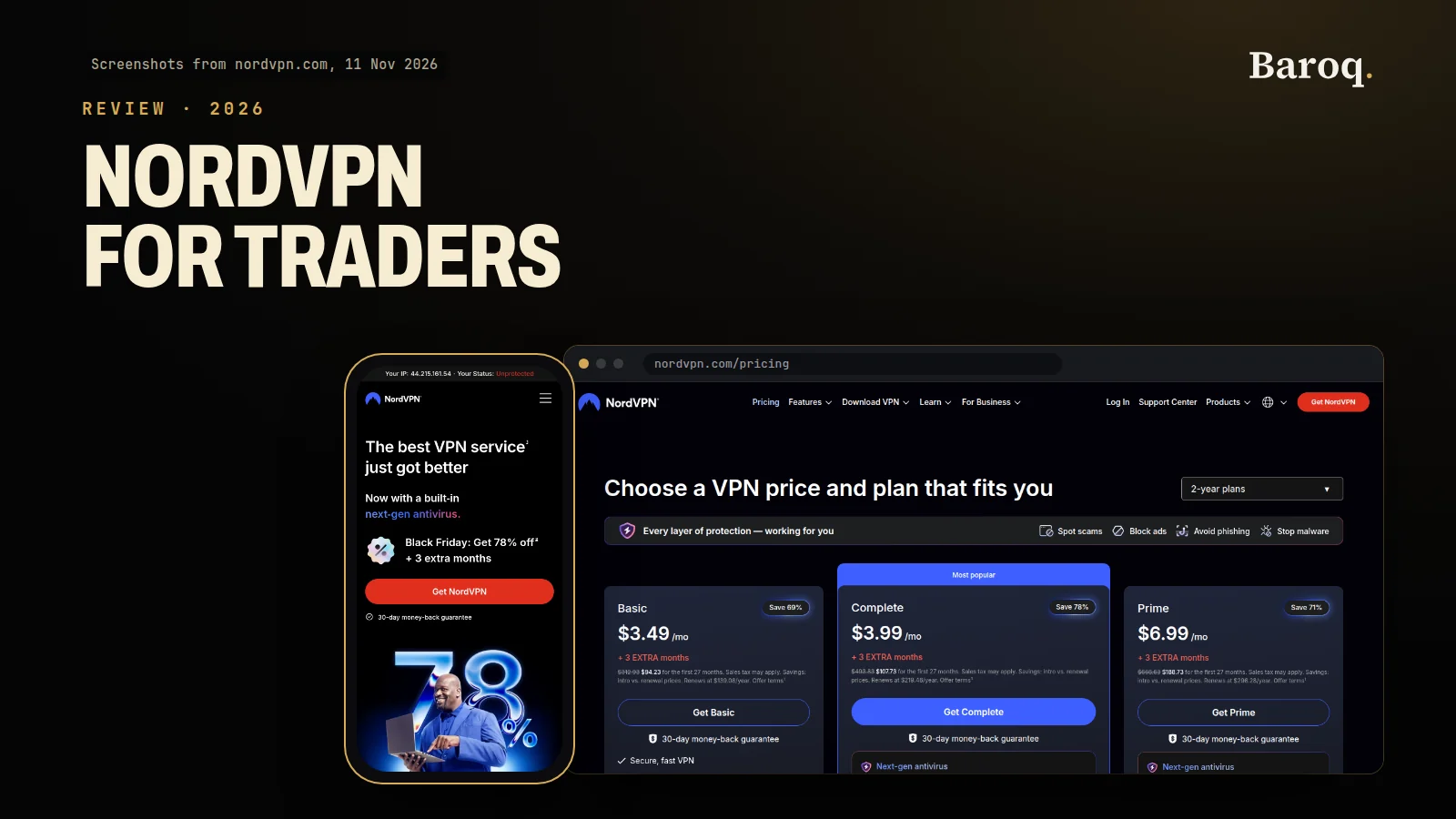
The pricing page groups the offers as a monthly plan, a "1-year" plan and a "2-year" plan. The longer two are not 12 and 24 months on the bill we read. The 1-year column is 15 months, described as a year plus three extra months. The 2-year column is 27 months, a two-year term plus three extra months. The monthly price in the headline is the intro total divided across those months. The charge is up front.
Figures from that US page on 10 November 2026:
| Plan | Monthly price | 15-month offer | 27-month offer | Renewal after the intro |
|---|---|---|---|---|
| Basic | $14.99 a month | $4.99 a month, $74.85 up front | $3.49 a month, $94.23 up front | $139.08 a year |
| Complete | $19.99 a month | $5.99 a month, $89.85 up front | $3.99 a month, $107.73 up front | $219.48 a year |
| Prime | $29.99 a month | $8.99 a month, $134.85 up front | $6.99 a month, $188.73 up front | $296.28 a year |
The page labels the gap between the intro monthly price and the renewal as a saving, and it says that sum can change by plan. We are not repeating those percentages as our own arithmetic. The two numbers that matter are the amount charged now and the amount charged when the term renews. For Basic, that is $94.23 now and $139.08 a year later. The first year of the renewal is already more than the entire 27-month intro.
What each plan includes
The comparison table on the same page is the useful part, because the VPN line is not where the plans differ.
Every plan includes the VPN, ten devices at once, scam and phishing protection, and Dark Web Monitor for up to five email addresses. The table describes scam and phishing protection as DNS filtering of ads and malicious domains while you are connected to the VPN. Dedicated IP is marked "add at checkout" on all three plans. Incogni, a tool for asking sites to remove personal data, is the same: an add-on, not a line in the subscription.
Complete and Prime add the items a trader might actually confuse with the VPN. The next-gen antivirus file scan, the ad and tracker blocker, and unlimited email protection for Gmail and Baroq data are marked desktop only, and they are not on Basic. Call protection, message protection, a password manager, 1 TB of encrypted cloud storage, Dark Web Monitor Pro (more emails, plus phone, card and ID numbers in selected countries), and bank-transaction alerts are on Complete and Prime. The bank alerts say "US bank accounts only".
Prime adds another layer that is easy to over-read: credit-freeze help, a monthly VantageScore from TransUnion, one-bureau credit monitoring, identity-theft cover up to $1,000,000, and cyber-extortion cover up to $100,000. The table says NordVPN is not a licensed insurance producer, that the benefits come from HSB Specialty Insurance Company, and that the cover is for US customers except residents of New York. If you do not live in the US, Prime's extra price is not buying you that cover. Read the summary of benefits before you treat the round number as a policy you hold.
For a trading login, Basic is the VPN. Complete is the plan if you want the desktop malware scan and the password manager in the same bill. Prime is an identity bundle with a US shape. Buying Prime to "get a better VPN" is not what the table says. The VPN line is marked included on all three.
The 30-day refund window
The pricing footnote says a refund of the subscription has to be requested within 30 days of the first purchase, by contacting support, which the page describes as available at all hours. Purchases made through Amazon, the Apple App Store or Google Play go back to those stores, not to NordVPN. We are describing that footnote. We did not request a refund, and we did not time a support reply.
The same footnote says you can cancel auto-renewal in the Nord Account and still use the service until the period you already paid for ends. For terms longer than a month, it says NordVPN emails before the renewal charge. Set a reminder on the day you subscribe. The intro price is the one people remember. The renewal is the one that is charged next.
What we like
- The 3 February 2026 post names a sixth no-logs review by Deloitte Lithuania, finished on 12 December 2025.
- Every plan on the pricing table includes the VPN and ten devices at once.
- The same table prints the intro total and the renewal, so the jump is visible before you pay.
- Meshnet is described on its own page as free, with a separate device cap from the paid VPN.
What to watch
- Basic renews at $139.08 a year after an intro of $94.23 for 27 months, on the US page we read.
- The Windows help text tells you to turn the Internet Kill Switch on. The App Kill Switch on Windows is off until you enable it.
- NordVPN says the full Deloitte report is behind a Nord Account, so we did not read the PDF.
- A dedicated IP is an add-on, and the plan table did not show its price.
Servers, protocols and the device limit
The trust center says "7,000+ servers covering 225 locations", and it says the machines are on 10 Gbps ports, that a large share are run in-house, and that server data sits in RAM so a power-off wipes it. The pricing page says "thousands of VPN servers covering 225+ locations". We report both lines. We did not count servers, and we did not open a data-centre door. A location is not the same thing as a country. The pages we read did not give one country total next to the 225 figure, so this review does not invent one.
The trust center also names specialty servers: Double VPN, and Onion Over VPN. The February 2026 post says the Deloitte work looked at standard VPN servers, Double VPN, obfuscated servers, and Onion Over VPN. A shared server means your visible address is one of many people on that machine. That is the normal product. A dedicated IP, below, is the opposite choice.
Protocols the apps actually list
The Windows help article says you can choose NordLynx, NordWhisper or OpenVPN under Settings, Connection and security, Protocol. The trust center says NordLynx is NordVPN's protocol built on WireGuard, and that NordWhisper is a separate protocol for networks where OpenVPN or WireGuard cannot get through. The macOS article says both the direct-download app and the App Store app include NordLynx, OpenVPN and NordWhisper, and that both include post-quantum encryption. The trust center says the same about post-quantum encryption: it is there so the tunnel is meant to stay hard to unwrap if quantum computers get further. That is the company's description of the design. We did not inspect the cipher.
The dedicated-IP support article is the one place IKEv2 appears in the pages we saved. It says a dedicated IP is not available via IKEv2. We are not listing IKEv2 as a protocol you should expect on a normal shared server, because the Windows chooser we read does not name it.
None of this is a speed ranking. NordLynx is NordVPN's own "fast" protocol in its marketing. On a congested public network the limit is often the Wi-Fi, not the protocol name. If a network blocks common VPN traffic, NordWhisper is the option the company tells you to try. We did not try it from a restricted network, and this article does not explain how to get around a block.
Ten devices, and what that does and does not cover
"10 devices secured at once" is a row on Basic, Complete and Prime. Phone, laptop and a tablet can share one subscription, which is the practical case for someone who travels with two or three machines. The cap is simultaneous connections, not a lifetime count of devices you have ever signed in.
Meshnet's cap is separate and larger, and it is not the same feature. The kill switch is also separate: it is a setting, not a device slot. A dedicated IP has its own, tighter rule when you use NordLynx.
Privacy and the no-logs reviews
A no-logs claim is a sentence until someone outside the company looks at the systems. NordVPN's history of those reviews is real, and the company's own pages do not tell it in one voice. Read the dated post first.
The review dated December 2025
The post of 3 February 2026 says NordVPN commissioned Deloitte Lithuania for an independent reasonable-assurance engagement under ISAE 3000 (Revised). It says the work ran from 10 November to 12 December 2025, and that the report was issued on 12 December 2025. It says practitioners interviewed staff and inspected server infrastructure, configuration and deployment, including standard VPN, Double VPN, obfuscated servers, and Onion Over VPN. It says Deloitte concluded that the IT systems and supporting operations are designed and implemented in line with NordVPN's no-logs statement. It also says the report is a point in time. It does not cover every day after 12 December 2025.
Two limits sit in the same post. First, "we don't publish excerpts". The full report is behind a Nord Account. This review did not read Deloitte's PDF, so the conclusion above is NordVPN's account of it, not our reading of the opinion. Second, a footnote says that during the engagement the next-gen antivirus was still called Threat Protection Pro, and that the change of name did not change what the feature does. The logging review and the antivirus product are different objects. Passing a no-logs review does not mean a file scan was part of that opinion.
Where the older pages disagree
The no-logs feature page, read the same day, says the first two reviews were by PricewaterhouseCoopers AG Switzerland and that later ones, including a fourth in 2023, a fifth in 2024 and a sixth in 2025, were by Deloitte. Further down, the same page says PwC reviewed the claim in 2018 and 2020, Deloitte in 2022, 2023 and 2024, and that all five reports found the policy valid. It also says "five-times verified" in the Panama paragraph. The trust center says the first independent check was in 2018 and that the no-logs claim was verified four more times after that, which is also five.
So the February 2026 post says six, and parts of the features page and the trust center still say five. We are not going to smooth that into one number. The post is the one with a start date, an end date, a firm name (Deloitte Lithuania) and a standard (ISAE 3000 Revised). The features page is the one that has not caught up with itself. If you want the primary document, it is the PDF behind the account, not either marketing count.
An earlier post, 11 February 2025, describes a fifth engagement by Deloitte, with access from 18 November to 20 December 2024, and the same pattern: the report sits behind a Nord Account. We did not open that PDF either.
What "no logs" does not hide
A VPN that does not keep a browsing log still sees your account email, your payment, and the fact that you have a subscription. The pricing FAQ says checkout asks for an email. Crypto is on the payment list (the FAQ names Bitcoin, Ethereum, Litecoin and stablecoin, among cards, PayPal and local bank methods). Paying in crypto is not the same thing as having no account. A NordVPN support note on using a dedicated IP on iOS says your email is linked to that address.
The server's country is also not Panama just because the company says it operates under Panama law. You pick a location in the app. That location is the address websites see. Panama is the legal home named for the logging policy. It is not an exit node you automatically get.
Logs the company says it does not keep cannot be handed over later. Logs your broker keeps, on its own side of the login, are untouched by any of this. So are the logs on a laptop that is lost, or a password reused from another site. The VPN is one layer. It is not the account.
Threat Protection, Meshnet and a dedicated IP
The features page still leads with the name Threat Protection Pro for malware, trackers and ads. The February 2026 footnote says that name was the next-gen antivirus at the time of the review. The pricing table uses the newer wording: anti-malware and browsing protection powered by next-gen antivirus, plus a separate row for scam and phishing protection.
For a trader the split is the one in the table. Scam and phishing filtering, while connected, is on Basic. The download scan, the ad and tracker blocker, and email-link warnings are desktop only and start on Complete. The Windows help article says you open the Protection tab and turn real-time protection on. It is a switch, like the kill switch. We did not run a malware sample, and we are not scoring the scanner. We are recording where NordVPN says it sits in the plan.
Dark Web Monitor on every plan watches up to five emails and alerts you if those addresses show up in dumps the company checks. That can be a useful nudge to change a broker password. It is not a promise that you will hear about every leak, and it is not a substitute for unique passwords and a second factor on the exchange itself.
Meshnet
The Meshnet page says Meshnet is open source and free, that it ships inside the NordVPN apps, and that a network can hold ten of your own devices plus up to fifty external devices, sixty in total. It is a direct encrypted link, closer to a private LAN than to a VPN exit in another country. The page lists file sharing, reaching a home PC while you are away, and routing traffic through a device you trust.
That last one is easy to misunderstand. If you route a laptop through a home computer, the visible address is the home connection, which you control, rather than a NordVPN server shared with strangers. It is still your home address. It does not inherit the no-logs story of the VPN server fleet, because the traffic is leaving through a machine you own. For a trading login on hotel Wi-Fi, the ordinary VPN server plus the kill switch is the feature the help articles describe. Meshnet is a useful extra for your own files. It is not the product you buy the 27-month plan for.
Dedicated IP
A normal NordVPN address is shared. A dedicated IP is one address that the support article says belongs to you alone. The pricing table says you add it at checkout on any plan. The table does not print the add-on price. We will not guess it. Check the checkout.
The support article says you can use that address on up to ten devices at once if you connect with OpenVPN (TCP or UDP), and that NordLynx allows only one connection at a time. It says the feature is not available via IKEv2. A note on the iOS dedicated-IP article says your email is linked to that address. The main dedicated-IP article says you can change the address once per subscription, by asking support. It lists cities in the United States, the United Kingdom, Germany, the Netherlands, France, Canada, Japan, Australia and a number of other countries. Panama is not on that list.
Why a trader might add one: some sites throw extra puzzles or temporary blocks at addresses that many VPN users share. A stable address of your own can reduce that. Why you might skip it: the address is tied to your account email, so it is a poorer fit if the whole point was to blend into a crowd. It also costs extra, at a price the plan table did not show. It does not change Panama law, and it does not move your broker's own logs.
Kill switch, platform by platform
The kill-switch support article is the one to read before a trip, because the control is not the same on every app.
- Windows. An Internet Kill Switch blocks the connection when you are not on a NordVPN server. An App Kill Switch closes programs you name if the VPN drops. The article says the App Kill Switch is off by default. The Windows install article tells you to open Settings and turn the Internet Kill Switch on. Do that before you type a broker password on public Wi-Fi.
- Android. On Android 8 and later the article describes a system-wide block when there is no VPN connection. It says the feature is not on an Amazon Fire TV Stick. It also points at Android's own Always-on VPN toggle, which you enable in the system VPN settings.
- iOS, and the macOS App Store app. The article calls the similar control VPN bypass prevention, managed under VPN connection in Settings. The macOS direct-download app has an App Kill Switch instead, because that build is not inside Apple's sandbox. The macOS version article says the Mac needs macOS 14 or later for that comparison.
- Linux. You enable it with `nordvpn set killswitch on`. The article gives the matching off command and a settings command to see the current state. It is not on until you run the command.
We did not click these switches. The instruction to turn them on is the help text, not a lab note from us. A kill switch that is off does nothing for the minute between a dropped tunnel and a reconnect. That minute is when a public network would otherwise see the traffic.
Who it suits
This NordVPN review is written for three uses. None of them is a claim about trading results.
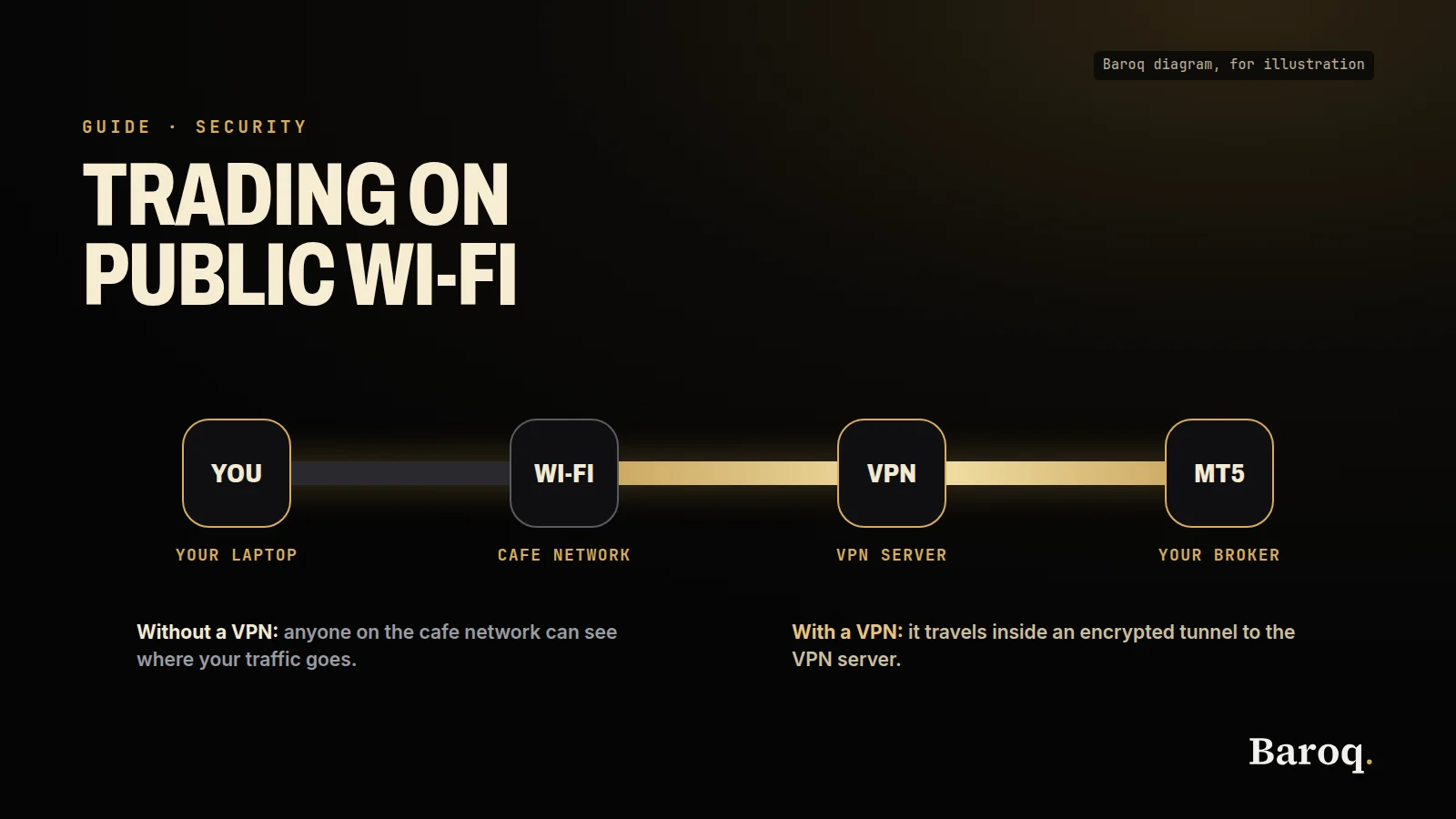
Public Wi-Fi. On a cafe, airport, coworking space or hotel network, the router and anyone else on that network are in a position to watch unencrypted traffic. The VPN moves the encrypted hop to NordVPN's server. The network can still see that you connected to a VPN. It should not see the broker page inside the tunnel. Turn the kill switch on first, using the steps for your app above. The VPN does not stop a fake site that you opened yourself. Check the address, and use the second factor the broker or exchange already gives you.
Travel. The same tunnel helps on a laptop in a new city, on a phone sharing its connection, and on a network that interferes with ordinary traffic. NordWhisper is the protocol NordVPN publishes for networks that block OpenVPN or WireGuard. Plans of a month exist if the trip is short: Basic at $14.99 for the month we saw, with no long renewal attached to that column. The long intro is cheaper per month only if you actually want the service after the trip. A platform may refuse customers in some countries. Using a VPN so that you appear to be in a country the platform does not serve can break that platform's terms. This article does not explain how to do that. Read the terms, and do not treat a server list as permission.
Broker and exchange logins. The VPN covers the path. The account still depends on the password, the device, and the recovery email. Dark Web Monitor can flag an email address. A password manager, on Complete and Prime, can store a unique password. Neither one logs you in. Neither one watches the position. Size the trade on its own terms, with a stop you can live with, on the position size calculator. Prices for the market itself are on Baroq Markets. A VPN subscription is a cost of connecting. It is not part of the edge.
Who should look elsewhere
Skip the long intro if you hate renewal jumps. The Basic renewal at $139.08 a year is the number to dislike, not the $3.49 headline. Skip it if you will not open Settings and enable the kill switch, because the Windows article does not describe that switch as already on. Skip it if you need the audit PDF in public without an account. Skip Prime if you are outside the US and the only reason was the insurance line. Skip any VPN, this one included, if your platform's terms forbid it.
A home connection you trust, with the broker's own second factor, does not require a VPN. Adding one is reasonable. Treating it as armour for a bad password is not.
Alternatives in brief
Three other names come up in the same conversation. They are plain text here. None of them is a partner link. None of them is a button. Prices move, so read their sites on the day you pay. Our side-by-side notes on a wider list, including these three, are in Best VPN for traders.
Mullvad is the flat-price comparison. It publishes one monthly rate rather than an intro that renews higher, and it is built so the VPN account is a number, not an email. The device cap is smaller than NordVPN's ten. Choose it when the renewal jump and the email on the account bother you more than you care about a December 2025 assurance post.
Proton VPN is the Swiss comparison. The company publishes open-source apps and a free plan. The free plan is the wrong place for several devices and for a login you care about: the limits are tight on purpose. The paid plan is the one to price against NordVPN's renewal, not against NordVPN's 27-month headline.
ExpressVPN is the British Virgin Islands comparison. The company has written up a KPMG review of its no-logs design, and its paid plans also start from a long intro with a higher renewal. Use it as a second column on jurisdiction and on the audit firm, then compare the renewal, not the crossed-out monthly price.
We did not measure connections for those three in this article, and we did not run a speed test on them either. The names are here so a NordVPN review is not a single advertisement. If a figure is not on this page, it is because we are sending you to the provider's own page rather than copying a number we are not showing the source line for.
What to do before you pay
- Open NordVPN's pricing page and write down the up-front charge and the renewal for the plan you actually want. Ignore the percentage.
- Decide Basic, Complete or Prime from the matrix, not from the badge that says most popular. If you only want the VPN, the matrix says Basic.
- If you are outside the US, do not pay for Prime's insurance line without reading the country limit.
- After install, turn on the kill switch for your app, using the support article for that app. On Windows that is a settings step. On Linux it is a command.
- Leave the protocol on the app default unless a network will not connect. NordWhisper is the published fallback, not a daily requirement.
- Add a dedicated IP only if shared addresses are causing blocks you can see, and only after the checkout shows the price. Remember that the email is linked to that address.
- Put a reminder in the calendar before the renewal date. Cancel auto-renewal in the Nord Account if you do not want the higher price.
- Keep the broker's own second factor on. The VPN is the path. The account is still the account.
Then go and check the market, not the tunnel. A calm way to see what gold and the other books are doing is Baroq Markets, and the learning pages on size and risk are under Guides.
The pages behind this NordVPN review, all read on 10 November 2026, are the pricing page (https://nordvpn.com/pricing/), the February 2026 assurance post (https://nordvpn.com/blog/nordvpn-no-logs-assurance-engagement-2025/), the no-logs feature page (https://nordvpn.com/features/no-log-vpn/), the trust center (https://nordvpn.com/trust/), the jurisdiction article (https://support.nordvpn.com/hc/en-us/articles/19441152966161-Where-is-NordVPN-based), the kill-switch article (https://support.nordvpn.com/hc/en-us/articles/19509682644369-NordVPN-Kill-Switch-how-does-it-work), the dedicated-IP article (https://support.nordvpn.com/hc/en-us/articles/19507808024209-Dedicated-NordVPN-IP-addresses), and the Meshnet page (https://nordvpn.com/meshnet/). If a line has changed, the page wins and this post should be updated.
Educational content, not financial advice. Prices, fees and offers change: check them on the provider's own site before you sign up. Trading leveraged products carries a high risk of losing money, and you can lose all of it.